
Adaptogens: The Ancient Stress-Fighting Herbs That Predate the Word by Thousands of Years
The word “adaptogen” shows up on tea boxes, supplement bottles, and wellness influencer captions constantly, and it feels like exactly the kind of term a modern marketing team invented last decade. It wasn’t. The word came out of a Soviet research program studying how to make soldiers and factory workers more resistant to stress. What genuinely surprised me digging into this is that even the word’s own origin story turns out to be shakier than most wellness blogs admit. And the plants themselves are old enough to make the Soviet research program look almost recent by comparison.
The Soviet Scientists Who Coined the Word
Most sources credit Russian toxicologist Nikolai Lazarev with coining “adaptogen” in 1947, describing substances that raise an organism’s general resistance to stress. A more rigorous 2010 review published in HerbalGram went back through the original Russian-language literature and found something the popular retelling skips entirely. It turns out the word doesn’t actually appear in print anywhere before 1957 or 1958, not even in Lazarev’s own comprehensive 1947 book on pharmacology. The concept existed earlier. The specific word just came later than the story usually claims.
Lazarev worked for the Soviet Ministry of Health, researching substances that might help industrial and military workers handle stress better. His student, Israel Brekhman, picked up the research through the 1960s and 1970s. He focused heavily on eleuthero, which people commonly sell as Siberian ginseng. Together with fellow researcher Dardymov, Brekhman refined the definition into three specific criteria in 1968. The substance had to be non-toxic at normal doses. It had to work non-specifically, meaning it raised resistance to a broad range of stressors rather than treating one particular problem. And it had to have a normalizing effect on the body, correcting both excess and deficiency depending on what the individual actually needed.
That third criterion is the strange one. A true adaptogen, by this definition, doesn’t just push the body in one direction. It’s supposed to calm an overactive system and stimulate an underactive one, depending on which one it’s dealing with.
Ginseng Was Worth More Than Its Weight in Gold
Long before any Soviet laboratory got involved, Chinese medicine had already built an entire tradition around Panax ginseng. Archaeological evidence for medicinal use of the plant goes back thousands of years. It appears in Shennong’s Herbal Classic, one of the oldest known compilations of medicinal plants in Chinese history. The name itself describes what people saw when they pulled it from the ground: rénshēn, or “man root.” The branching shape of a mature root genuinely resembles a small human figure, arms, legs, and all.
That resemblance fed directly into the plant’s mythology. Multiple regional legends describe villagers hearing crying or wailing at night, only to find a human-shaped root buried beneath a bush as the source. Chinese emperors eventually reserved the best wild ginseng for themselves, and its value climbed past its weight in gold. A trade industry built entirely around the root took shape by around the third century and never really stopped. When the German botanist Carl Meyer formally classified the genus in 1842, he named it Panax. That name came from the Greek for “all-healing,” the same root that gives us the word panacea.
Ashwagandha and the Smell That Gave It a Name
Indian Ayurvedic medicine, one of the world’s oldest continuously practiced medical systems, incorporated ashwagandha, Withania somnifera, at least 3,000 years ago. The name itself comes from Sanskrit and translates roughly to “smell of horse,” a description that works two ways at once. The fresh root genuinely carries an earthy, slightly pungent scent. Traditional belief held that consuming it could grant the strength and vitality of a horse. Ayurvedic tradition classifies it as a rasayana, a category of substances specifically meant to promote longevity, vitality, and resilience against age and stress. That framework lines up almost precisely with what Soviet scientists would define centuries later, using entirely different language and an entirely different set of assumptions.
Holy basil, or tulsi, occupied a similarly central place in the same tradition, considered sacred in Hindu religious practice and used medicinally for a comparably long stretch of history. Neither plant needed a laboratory definition to earn a permanent place in daily use across an entire subcontinent.
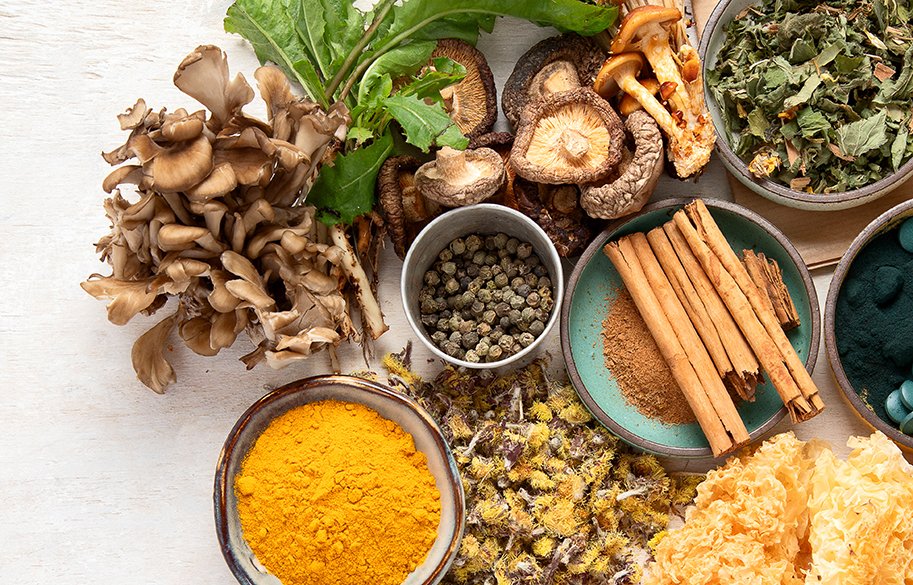
Rhodiola and the Soviets’ Own Backyard
While Chinese and Indian traditions were developing ginseng and ashwagandha over millennia, a parallel tradition took shape much closer to where Lazarev and Brekhman actually worked. Rhodiola rosea grows wild across the Arctic and Siberian regions. Scandinavian and Russian folk medicine had used its root for generations before any formal scientific study existed. Soviet researchers studying adaptogens found it sitting practically in their own backyard. It became one of the most heavily studied plants in the entire program. Researchers tested it specifically on soldiers, athletes, and eventually cosmonauts, part of a state-level effort to build a biological edge for people operating under extreme physical and mental strain.
Schisandra chinensis joined the same research list. Chinese hunters and travelers had used it for centuries specifically to sustain stamina during long treks, and its Chinese name translates to something like “five flavor fruit,” a reference to the belief that it contained all five basic tastes at once.
What the Modern Science Actually Says
Here’s where it’s worth being honest rather than promotional. Despite decades of research, no major regulatory body, not the FDA, not the European Medicines Agency, has ever formally adopted “adaptogen” as an official pharmacological category. The word remains scientifically descriptive rather than regulatory. That means it shows up constantly in marketing without the kind of standardized backing that a term like “antibiotic” carries. Some of the plants grouped under this label do have real, replicated research behind specific effects. Others rest on considerably thinner evidence. The strength of that evidence varies significantly from one herb to the next rather than applying uniformly across the whole category.
None of that erases what these plants actually represent historically. Ayurvedic physicians in India, Taoist herbalists in China, and folk healers across Siberia all converged independently on roughly the same idea, separated by thousands of miles and centuries of time, with no contact or shared framework whatsoever. Certain plants, they each concluded, could help a stressed, depleted body find its way back toward balance. Soviet scientists eventually gave that shared intuition a formal name and a testable definition in the mid-20th century. The plants themselves had already been doing the actual work, unnamed, for thousands of years before anyone in a laboratory got around to asking why.
Recent Podcast Episodes

Recent Adventures


Subscribe Today!
Subscribe
Your Ad Here!

Other Adventures You May Like
Viking Misconceptions That Still Won’t Go Away, According to People Who Study Vikings

The Imperial Regalia of Japan: The Three Sacred Treasures No Emperor Has Ever Actually Seen
