How Crowd Dynamics Actually Works, and Why Crowds Turn Deadly
Every time a crowd disaster makes headlines, the same word shows up: stampede. People picture panic, trampling, everyone running in different directions. Here’s the thing though. That’s almost never actually what happened. Getting this wrong isn’t just a media annoyance either. It’s part of why these disasters keep repeating.
It’s Not Trampling, It’s Compressive Asphyxia
Most people who die in crowd disasters die standing up. Not from being knocked down and stepped on. It’s from being squeezed so tightly by the people around them that their chest physically cannot expand to breathe. It’s called compressive asphyxia. Medical examiners, crowd researchers, and disaster management authorities have confirmed it as the actual cause of death in the overwhelming majority of these events.
That distinction matters more than it sounds like it should. If you call it a stampede, the fix looks like crowd control, more police, calmer behavior, less panic. If you call it a crush, caused by density, the fix looks completely different, better exits, real-time density monitoring, capacity limits actually enforced. One of those approaches addresses what’s actually killing people. The other one doesn’t.
At a Certain Point, a Crowd Stops Being People and Starts Being a Fluid
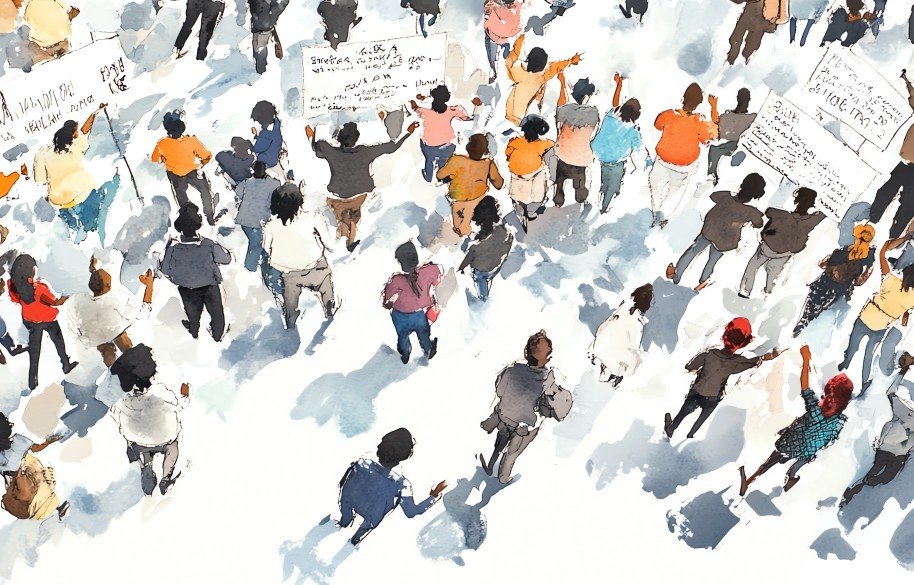
Crowd scientist Keith Still found a specific threshold that changes everything. Once density crosses roughly six people per square meter, individual control basically disappears. You can want to move left all you want. The crowd around you decides otherwise. At that point, researchers say the crowd starts behaving less like a group of individuals and more like a fluid.
Here’s the part I found genuinely unsettling once I actually understood it. Water compresses smoothly and evenly when squeezed. People don’t. Human bodies are relatively incompressible, so instead of the pressure spreading out safely, it builds. Pressure waves start moving through the crowd on their own. They’re capable of literally lifting people off their feet or knocking them over, without a single person in that crowd ever deciding to push anyone. Researchers even have a term for it: crowd turbulence. It’s not a metaphor. It behaves like actual fluid turbulence, just made of people instead of water.
Scientists Found a Warning Sign Hiding in Plain Sight
A physicist named Denis Bartolo spent years studying an extremely dense annual gathering, mounting cameras on nearby buildings rather than risking stepping into the crowd himself. What he found was strange. Above a certain density, the crowd wasn’t actually chaotic. People inside it were moving in slow, circular patterns, oscillating almost like a mathematical pattern nobody had planned or coordinated. Nobody in the crowd was doing this on purpose. It just started happening once density crossed a specific line.
Then his team checked surveillance footage from the 2010 Love Parade disaster in Duisburg, Germany, where 21 people died in a crush. The same oscillation pattern showed up there too, just before the crush began. If that holds up, it means these patterns could function as an actual early warning sign. Event organizers could watch for it and act before density crosses into genuinely lethal territory.
A History That Keeps Repeating, Across Very Different Places
Crowd disasters aren’t new, and they aren’t limited to any one culture or type of event. In 1896, a crush during festivities for the coronation of Russia’s Nicholas II killed more than 1,280 people. In 2010, it was a German music festival. Then, in 2021, a religious gathering in Meron, Israel, left 45 dead. In 2024 alone, a stampede at a stadium in Nzérékoré, Guinea, killed at least 56 people, and a concert crush in the Democratic Republic of Congo killed seven more.
The hajj, the annual Islamic pilgrimage to Mecca, has produced some of the deadliest events on record. That’s specifically because of the sheer scale involved, millions of people converging on the same narrow physical space at once. A 1990 tunnel disaster there killed 1,426 people. A 2004 crush at the Jamarat Bridge killed 251. A second one there in 2006 killed 363 more.
The Forces Involved Are Genuinely Hard to Believe
I didn’t fully grasp how strong these forces get until I read the actual numbers. Investigators studying crowd disasters have found bent steel railings at several sites. Some were twisted by forces exceeding 4,500 newtons, somewhere around 1,000 pounds of pressure. That’s not a crowd being unruly. That’s raw physical force, generated collectively by hundreds of ordinary people standing close together. None of them were individually trying to hurt anyone.
This is also, strangely, an old problem that only got a real mathematical framework fairly recently. In 1995, physicists Dirk Helbing and Peter Molnár introduced what’s called the social force model. It describes pedestrian movement using a set of measurable forces that influence how people navigate space around each other. That model became the foundation for basically everything crowd scientists do today. It’s used for predicting evacuation times and identifying exactly where a specific venue is likely to develop a dangerous crush point, sometimes before a single ticket even goes on sale.
The Rare Case Where the Science Actually Fixed the Problem
After the 2006 disaster, Saudi authorities did something most places never do after a tragedy like this. They brought in the actual crowd physics researchers, including Dirk Helbing, whose landmark 2007 study had mathematically described exactly how these crushes form. Together, they redesigned the entire Jamarat Bridge site around what the physics said would actually work. Engineers replaced the circular pillars and reshaped the flow paths. They applied the same principles architects use for laminar flow in fluid systems.
It worked. Keith Still’s research has since been used for other high-density events too. That includes planning crowd safety for the 2011 royal wedding of Prince William and Kate Middleton in the UK. Modern venues increasingly monitor crowd density in real time using cameras and computer analysis. They’re watching specifically for the kind of buildup that tends to come right before things go wrong.
None of this required blaming anyone’s behavior. Researchers are fairly blunt about that part. Most crowd crushes aren’t caused by people acting badly, panicking, or pushing on purpose. They’re caused by too many bodies in too little space, with nowhere safe for that pressure to go. Fix the space, and in a lot of cases, you fix the disaster before it ever happens. Keep calling it a stampede instead, and you’re solving a problem that was never actually the real one.
Recent Podcast Episodes

Recent Adventures


Subscribe Today!
Subscribe
Your Ad Here!

Other Adventures You May Like
Kitty Genovese and the “38 Witnesses” Story That Turned Out to Be Wrong
The Rohonc Codex: The Other Undeciphered Manuscript Nobody Can Crack