
Speed and Tradition Along Korea’s Coast
A Journey Between City and Sea
South Korea’s eastern and southern shores reveal a country where rapid modernisation exists alongside deeply rooted traditions. Seoul may dominate international impressions of Korea, but travelling south introduces a different rhythm, shaped by coastal landscapes, historic neighbourhoods, fishing ports and centuries-old cultural sites.
Busan is the natural focus of this journey. As Korea’s second-largest city and one of its busiest ports, it combines beaches, markets and contemporary districts with temples perched above the sea. Beyond the city, smaller coastal communities and historic towns offer further insight into the country’s regional character.
Seoul’s Gateway to the South
Although this journey centres on Korea’s coast, Seoul provides a useful starting point. The capital is an enormous urban centre where royal palaces, shopping districts, museums and high-rise developments exist within the same metropolitan area.
Gyeongbokgung Palace offers a striking reminder of the Joseon dynasty. Its courtyards and traditional gates contrast sharply with the modern skyline visible beyond the palace grounds. Nearby Bukchon Hanok Village preserves traditional Korean houses, while Insadong is known for galleries, craft shops and tea houses.
For travellers heading towards the coast, the KTX train provides a fast connection from the capital to the southern part of the country. The journey makes it possible to move quickly from Seoul’s dense urban environment towards Busan, where the landscape and atmosphere begin to change.
Arriving in Busan
Busan stretches between mountains and the sea, creating a distinctive setting for a major city. Its waterfront districts range from busy commercial areas to long sandy beaches, while hills rise behind many neighbourhoods.
Haeundae Beach is perhaps the city’s best-known coastal landmark. Modern hotels and restaurants surround the broad waterfront, and the area becomes especially lively during warmer months.
Gwangalli offers a different view, with Gwangan Bridge illuminated across the water after dark. Cafés and restaurants line the shore, making it a popular place to watch the city lights while listening to the sea.
Busan’s character becomes even clearer away from the main beaches. Markets, residential streets and hillside communities reveal a more everyday side of the city.
The Journey South by Rail
The Seoul to Busan train tickets are worth arranging with the journey’s timing in mind, particularly during busy travel periods. Rail travel is one of the easiest ways to cover the distance between Korea’s two major cities while keeping the itinerary relatively flexible.
The route provides a fascinating contrast between the capital and the southeast. As the train leaves Seoul, the urban landscape gradually gives way to smaller settlements, agricultural areas and hills before Busan’s metropolitan surroundings appear.
This change in scenery is part of the attraction. Rather than treating the journey as a simple transfer, travellers can use it to understand how Korea’s densely populated cities connect with the wider countryside.
Jagalchi and the Taste of the Coast
Busan’s relationship with the sea becomes particularly obvious at Jagalchi Market. The market is famous for its enormous range of seafood, with stalls and restaurants reflecting the importance of fishing to the city’s history.
Walking through the market reveals a side of Busan that feels very different from the polished waterfront districts. Vendors prepare fish and shellfish while shoppers browse the day’s catch, creating a lively atmosphere that has remained closely connected to the city’s maritime identity.
Nearby BIFF Square adds another dimension. The area is associated with the Busan International Film Festival and has developed into a busy entertainment district filled with street food, cinemas and shops.
Trying local snacks is part of the experience. Hotteok filled with seeds and nuts is particularly popular, while seafood features prominently throughout the city’s restaurants.
Temples Above the Water
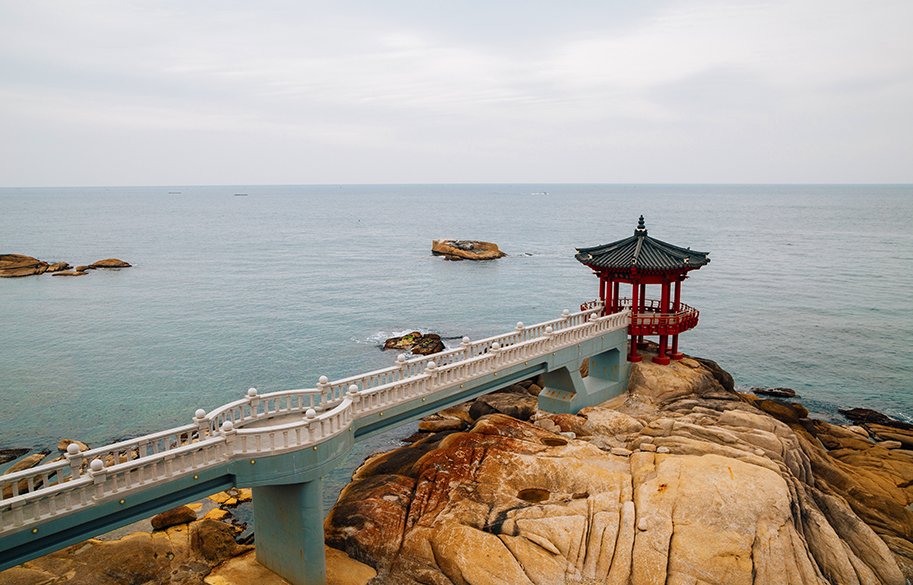
One of Busan’s most memorable cultural sites is Haedong Yonggungsa, a Buddhist temple complex built beside the coast. Unlike many Korean temples located deep within mountain landscapes, this one occupies a dramatic position overlooking the sea.
Stone stairways descend towards the temple buildings, while statues and traditional architectural details are framed by cliffs and waves. The setting creates an unusually strong connection between religious architecture and the natural environment.
The temple is particularly atmospheric early in the day, when the coastal light changes the appearance of the surrounding rocks and water.
For visitors interested in Korean history, the site also demonstrates how Buddhist traditions have adapted to very different landscapes across the peninsula.
Gamcheon’s Hillside Palette
Gamcheon Culture Village offers another distinctive perspective on Busan. Houses climb the hillside in tightly packed rows, creating a colourful pattern above the narrow streets.
The neighbourhood was shaped by refugees during the Korean War and later underwent regeneration that transformed it into a cultural destination. Murals, sculptures, workshops and small galleries now appear throughout the village.
Yet the area remains residential, so exploring it requires some awareness of everyday life. The narrow lanes, staircases and elevated viewpoints make wandering here feel quite different from sightseeing around Busan’s major commercial districts.
The views are a major attraction. From higher points, the densely packed houses stretch towards the sea, demonstrating just how closely Busan’s urban development is tied to its mountainous geography.
Coastal Traditions Beyond Busan
The wider southeastern coast offers opportunities to discover smaller communities where fishing, local markets and traditional food remain important parts of daily life.
Historic towns and coastal parks provide a quieter alternative to Busan’s energetic streets. Visitors can spend time walking along harbour promenades, sampling regional seafood or simply watching boats move across the water.
Korea’s coastline also has numerous islands, rocky outcrops and beaches. Some are developed for tourism, while others retain a much more secluded atmosphere.
The contrast between modern infrastructure and traditional coastal life is particularly interesting. High-speed trains can carry passengers rapidly between major cities, yet once outside the metropolitan centres, older ways of living remain visible.
Korean Food with a Southern Accent
Food provides another reason to explore Busan and the surrounding region. The city’s proximity to the sea means seafood features heavily, but the local culinary tradition extends well beyond fish.
Dwaeji-gukbap, a pork and rice soup, is strongly associated with Busan. Warm and substantial, it reflects the city’s preference for comforting dishes that suit its working-port history.
Milmyeon is another local speciality. These chilled wheat noodles are served with broth or a spicy sauce and are particularly refreshing during warmer weather.
Markets and small neighbourhood restaurants are often the best places to encounter these dishes. The atmosphere tends to be informal, with food prepared quickly and served without ceremony.
Where Modern Korea Meets Its Heritage
Busan demonstrates how Korea’s rapid transformation has not erased older traditions. Skyscrapers stand close to markets, high-speed rail connects distant cities, and contemporary cultural venues operate alongside Buddhist temples and historic neighbourhoods.
The city also shows how geography can influence urban identity. Mountains restrict development in some areas, while the sea creates both economic opportunities and recreational spaces.
For travellers, this makes Busan particularly rewarding. It is possible to spend a morning exploring a historic temple, an afternoon beside the ocean and an evening in a busy entertainment district without leaving the same city.
A Coastal Journey Worth Taking Slowly
Korea’s high-speed rail network makes travelling between major cities remarkably efficient, but the destinations themselves deserve time. Seoul introduces the scale and energy of contemporary Korea, while Busan reveals a more coastal identity shaped by fishing, trade, beaches and mountain landscapes.
The journey south is therefore more than a change of location. It is a gradual shift from royal palaces and enormous shopping districts towards seafood markets, seaside temples and neighbourhoods built into hillsides.
What makes the route memorable is the balance between speed and tradition. Modern trains cover long distances in a short time, yet the landscapes and communities beyond the stations remind visitors that Korea’s identity has been shaped over centuries. From Seoul’s busy avenues to Busan’s open coastline, the journey offers a vivid glimpse of a country moving confidently forward without leaving its past behind.
Recent Podcast Episodes


Recent Adventures


Subscribe Today!
Subscribe
Your Ad Here!

Other Adventures You May Like

Nils Olav, the Penguin the Norwegian Army Keeps Promoting

A Guide to Caravan Sales in NSW for First-Time Buyers
