
The Lascaux Cave Paintings: The 17,000-Year-Old Art That Almost Got Destroyed by the People Who Saved It
Four teenage boys went looking for their dog on September 12, 1940. Somewhere in the woods near Montignac, in southwestern France, the dog had disappeared down a hole. The boys followed. What they found underground had sat sealed away from human eyes for roughly 17,000 years. They had stumbled into Lascaux, one of the greatest collections of prehistoric art ever discovered. The paintings survived untouched for millennia in complete darkness. They nearly didn’t survive the next twenty years, once people started actually visiting them.
What Four Boys Found in the Dark
Marcel Ravidat, Jacques Marsal, Georges Agnel, and Simon Coencas had no idea what they were walking into. They followed the narrow shaft down and emerged into a series of underground chambers covered in painted animals. Bulls. Horses. Deer. Bison. A strange two-horned creature nobody could identify, later nicknamed the unicorn for lack of a better name.
The centerpiece is a chamber now called the Great Hall of Bulls. Four massive aurochs dominate it, an extinct species of wild cattle, some stretching up to 18 feet long. Altogether, the cave contains roughly 600 painted and drawn figures and nearly 1,500 engravings. Artists rendered them in red, black, brown, and yellow pigment, made from ground minerals like ochre and charcoal. Horses appear more often than any other animal. Deer, bison, and the occasional bird or human figure fill out the rest, alongside rows of dots and geometric symbols nobody has ever fully interpreted.
In 1979, UNESCO designated Lascaux a World Heritage Site, grouped together with roughly two dozen other decorated caves and around 150 prehistoric settlements scattered across the same Vézère River valley. Prehistoric people clearly found something about this specific stretch of French countryside worth returning to, over and over, for thousands of years.
The artists who made all this never lived in the cave itself. They brought fire in with them, torches or lamps burning animal fat, specifically to see what they were painting in total darkness. Some of the highest sections of wall and ceiling show signs that the painters built scaffolding to reach them. Nobody knows for certain why they made any of it. Some researchers believe the paintings served a religious or ceremonial purpose rather than a purely decorative one. That debate has never fully settled either way.
A Popularity That Turned Into a Slow Disaster
Word of the discovery spread fast, even through a country in the middle of a world war. By 1948, once the war had ended, French officials opened Lascaux to the public. People came from everywhere. At its peak, the cave drew as many as 1,200 visitors a day. That added up to roughly 120,000 people a year, passing through chambers that had known no human presence for seventeen millennia. Nobody visiting meant any harm. The damage happened anyway, simply because so many people were breathing.
Human breath carries carbon dioxide, heat, and moisture. Multiply that by over a hundred thousand visitors annually, inside an enclosed underground space, and the cave’s climate started changing in ways it never had before. Condensation built up on the walls and ceiling. Moisture ran down directly over the ancient pigment. Lichen and mold began colonizing the same surfaces the paintings sat on. Powerful artificial lighting, installed so visitors could actually see the art, accelerated the fading and discoloration. Some visitors reportedly fainted, the air inside had grown so thick and altered.
Seventeen thousand years of survival in total isolation. Fifteen years of public visits nearly undid it.
Sealing It Back Up to Save It
In 1963, French Minister of Culture André Malraux ordered Lascaux closed to the general public. From that point forward, only a small number of scientists and conservators could get inside. It was a drastic decision. It closed off one of the most significant archaeological discoveries of the 20th century from the very people who wanted to see it.
Closing the doors did not immediately fix the problem. Fungus and mold continued appearing on the walls for decades afterward. Conservationists faced an ongoing, difficult fight, simply trying to hold the deterioration in place rather than reverse it. In 2009, the French Ministry of Culture brought together close to 300 experts from multiple countries in Paris. They focused on a single question. How do you stop a 17,000-year-old artwork from continuing to disappear, even after sealing it away from the public that endangered it in the first place?
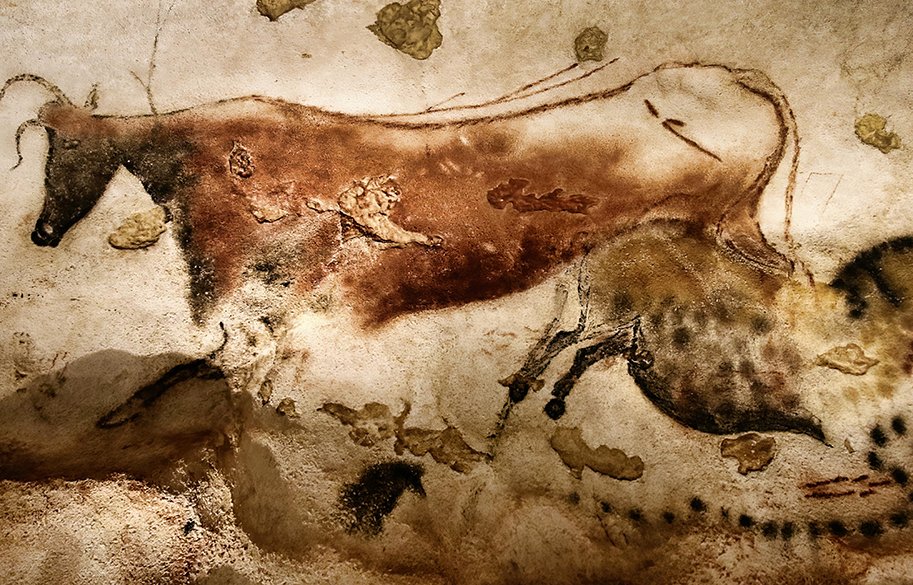
Today, access to the original cave stays almost unimaginably restricted. Steel doors and security cameras guard the entrance. The interior sits in complete darkness at all times. The rare visitors who do get inside, mostly researchers conducting maintenance or scientific study, wear sterile white overalls, latex gloves, and shoe covers. They view the paintings only by the dim glow of a small LED headlamp. That’s roughly the same amount of light the original painters themselves would have had, just with slightly better technology strapped to their foreheads.
The Solution Was to Build It Again, Somewhere Else
Rather than let the public lose access to Lascaux entirely, French authorities decided to recreate it. In 1983, twenty years after the original closure, a meticulously constructed replica called Lascaux II opened nearby. It reproduced roughly 80 percent of the original cave’s paintings with remarkable precision. It draws around 300,000 visitors every year, a number the fragile original could never safely support again.
Lascaux II was only the beginning. A traveling exhibition version, Lascaux III, followed, letting the art tour internationally without moving the actual walls. Then, in 2016, an even more ambitious facility opened: Lascaux IV, the Centre International de l’Art Pariétal. Builders used high-resolution imaging and advanced 3D scanning to recreate the paintings, reaching a level of accuracy the original 1983 replica couldn’t achieve. Modern digital tools now let researchers study the cave’s surfaces and structure in extraordinary detail, without setting foot inside at all. Those same tools let the general public explore versions of it online, from anywhere in the world.
Recent Podcast Episodes

Recent Adventures


Subscribe Today!
Subscribe
Your Ad Here!

Other Adventures You May Like

Unraveling Local Legends Through Travel

What Makes a Professional Travel Proposal Stand Out to Clients?
