The Ring of Brodgar: Scotland’s Mysterious Neolithic Stone Circle
On a narrow strip of land between two lochs in Scotland’s Orkney Islands, dozens of ancient stones still stand. Someone put them there roughly 4,500 years ago. Nobody fully knows why they’re there. Nobody fully knows what happened inside that circle. And it’s older than the Great Pyramids of Egypt. This is the Ring of Brodgar, and it’s one of the most genuinely enigmatic places in the British Isles.
A Circle Big Enough to Swallow Stonehenge
Today, 27 of an original 60 standing stones remain upright at Brodgar. They’re cut from red sandstone, ranging from about 7 to 15 feet tall. The circle itself stretches roughly 340 feet across. That makes it the third largest stone circle anywhere in the British Isles, behind only Avebury and Stanton Drew. Stonehenge, for comparison, could fit entirely inside it.
A massive ditch surrounds the whole thing, cut directly into bedrock by hand. It stretches about 404 feet across at its widest point. Builders working with nothing but stone and antler tools carved that ditch out of solid rock. That alone represents a staggering amount of coordinated labor for a Neolithic community.
Older Than the Pyramids, Younger Than Its Neighbor
Most estimates place Brodgar’s construction around 2500 BCE, which makes it older than the pyramids of Giza. It’s actually younger than two of its own neighbors, though. The nearby Stones of Stenness came earlier, and Stonehenge itself began taking shape a few centuries before Brodgar too.
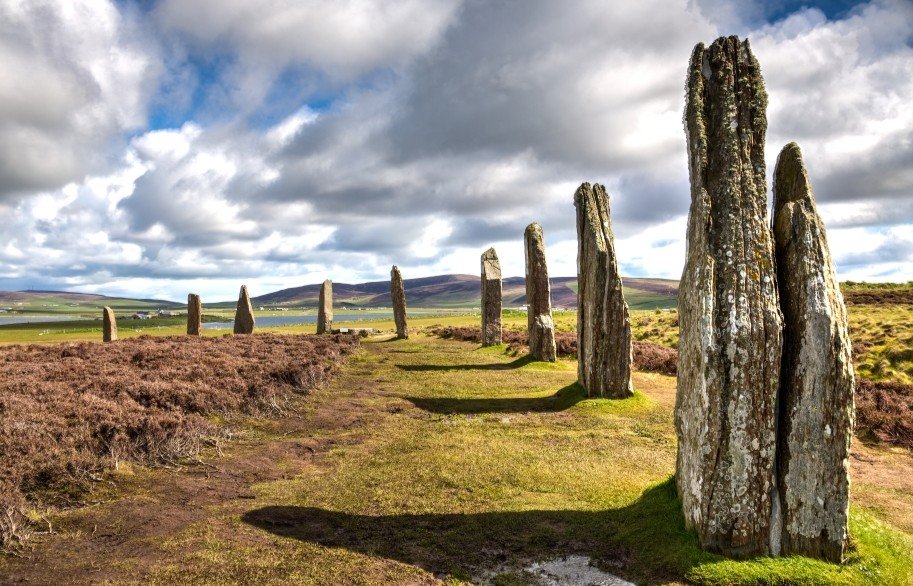
The stones didn’t come from nearby, either. Evidence points to a quarry at Vestrafiold, roughly 8 miles away. Archaeologists have found hammerstones, flint tools, and partially quarried stone remnants still sitting at that quarry site. One popular theory, floated in a BBC documentary on ancient Britain, offers an answer. Workers may have dragged each massive stone the full 8 miles by rope. Whether or not that’s exactly how it happened, something like it had to.
Nobody Actually Knows What Happened Here
There’s very little direct evidence for what ceremonies or rituals actually took place inside the circle. Some researchers think it connected living communities with their ancestors. Others suggest the site was used to track the moon’s cycles across the sky.
Excavations at the neighboring Ness of Brodgar site turned up something that adds real weight to the mystery. Archaeologists found walls stretching across the width of the peninsula. Those walls would have physically controlled who could approach the Ring at all. This wasn’t an open public square. Someone deliberately restricted access to it.
Brodgar isn’t standing alone. It’s one of four sites that make up the Heart of Neolithic Orkney UNESCO World Heritage designation. The other three are the Stones of Stenness, the chambered tomb of Maeshowe, and the ancient village of Skara Brae. That’s an unusually dense concentration of major prehistoric sites, all packed into one small stretch of land. It suggests this exact spot functioned as a genuine ceremonial center for the wider region.
The adjacent Ness of Brodgar dig ran from 2002 all the way to 2024. It uncovered an enormous stone wall nearly 20 feet thick, along with a building some archaeologists describe as almost temple-like. Once excavation wrapped up, the team deliberately reburied the site. They filled it back in specifically to protect everything they’d exposed from the elements.
Recent Podcast Episodes

Recent Adventures


Subscribe Today!
Subscribe
Your Ad Here!

Other Adventures You May Like
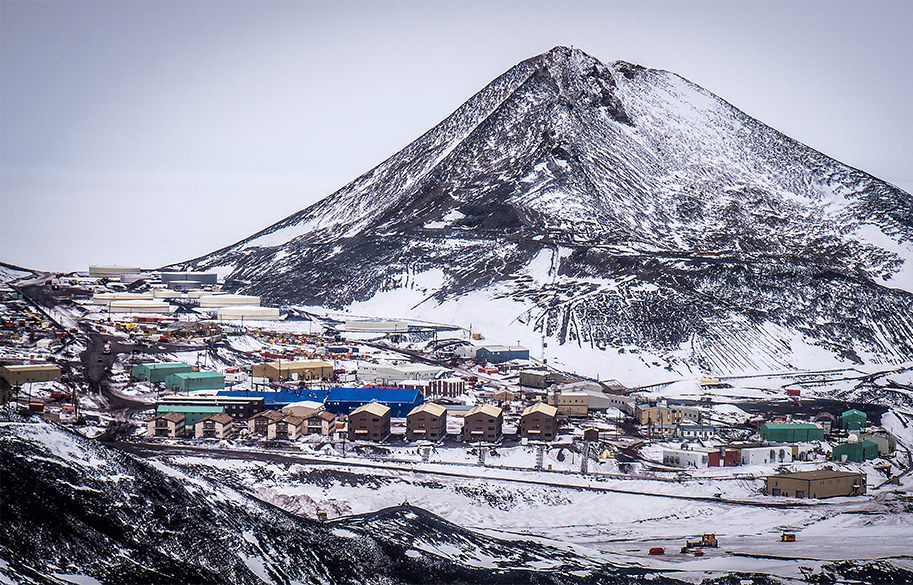
The Largest Settlements in Antarctica, and What They’re Actually For

The Elephant Graveyard Myth: Why It’s Not Real, and What’s Actually Going On