
Villa Pisani’s Hedge Maze: The Center Nobody Can Find Without Getting Lost
A hedge maze outside Venice has nine concentric rings and dozens of dead ends. The hedges are tall enough that once you’re inside, you genuinely cannot see over them. It was built years before the grand villa next to it even existed. According to local legend, some of history’s most powerful men took one look at it. They decided not to risk it. Here’s all you need to know about Villa Pisani’s Hedge Maze.
A Maze Built Before Its Own Villa
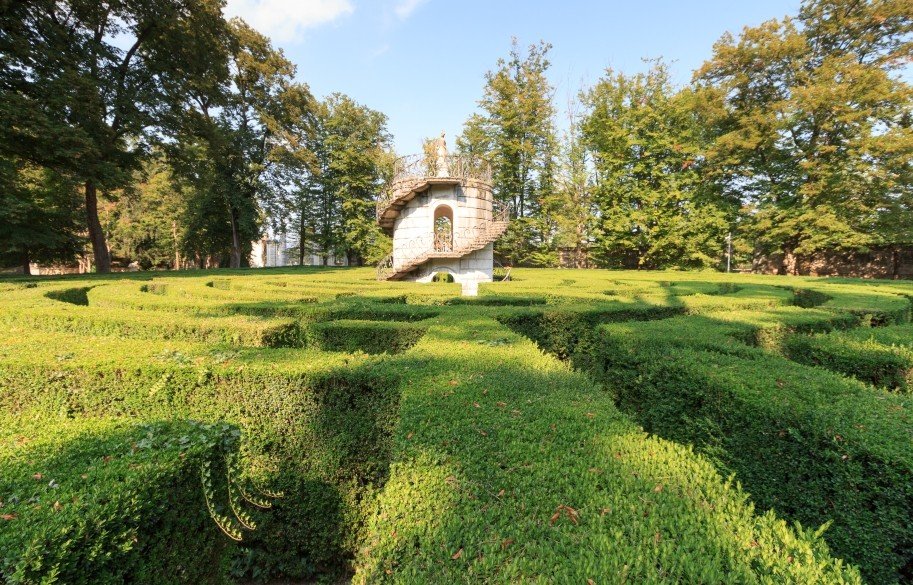
The maze sits on the grounds of Villa Pisani in Stra, along the Brenta Canal between Venice and Padua. Architect Girolamo Frigimelica designed it in 1720 for Alvise Pisani, a wealthy Venetian nobleman. That’s a full 15 years before construction even began on the villa itself. The design follows a classic circular medieval pattern, nine repeating concentric layers wrapped around a small central tower.
At the center, a double spiral staircase leads up to a statue of Minerva, the goddess of wisdom. She watches over a structure built specifically to confuse everyone who enters it.
A Doge With a Number Obsession
Pisani became the 114th Doge of Venice in 1735, the same year construction started on his new villa. That number shows up again in the finished building, which ended up with exactly 114 rooms, likely no coincidence. Pisani only held the position for six years before his death in 1741. He ruled during the declining, increasingly hedonistic final decades of the Venetian Republic. Only six more doges would follow him before the Republic collapsed entirely in 1797.
The villa itself matched its owner’s ambitions. Thirty acres of grounds surrounded the main house. Elaborate follies filled the space, along with a reflecting pool modeled on Versailles, a small hilltop ice house, an artificial forest, and false hills built purely for visual effect. Inside, painted ceilings and walls showed off Greek gods, family celebrations, and trompe l’oeil effects designed to trick the eye.
Napoleon Owned It, But Barely Stuck Around
Napoleon seized Villa Pisani in 1807 after conquering Venice and handed it to his stepson, Eugène de Beauharnais. Local lore holds that Napoleon himself once got lost inside the maze, though nobody can actually confirm it happened. A smaller, funnier detail survives with better documentation. The villa still displays a tiny wooden throne Napoleon reportedly used as, well, exactly what it sounds like.
The Meeting That Actually Happened
Here’s the part of Villa Pisani’s history that isn’t legend at all. In June 1934, the villa hosted the first-ever face-to-face meeting between Adolf Hitler and Benito Mussolini. Mussolini showed up in a showy military uniform and riding boots. Hitler arrived in a plain beige trench coat. By most accounts, he looked distinctly less impressive than the man he’d come to meet. The two men reportedly shook hands beneath a ceiling painted with allegorical figures representing the Geniuses of Peace. Historians still find that detail darkly ironic, given everything that followed over the next decade.
According to local legend, neither dictator actually entered the hedge maze during that visit. Unlike Napoleon, who supposedly wandered in and got lost, Hitler and Mussolini apparently kept their distance entirely.
Napoleon wasn’t the only notable name to pass through Villa Pisani’s rooms, either. The villa’s collection reportedly still includes the sagging bed King Vittorio Emanuele II once slept in during his own stay there. Between them, the tiny throne and the worn-out royal bed offer something genuinely intimate. They show how differently history’s biggest names actually lived once the public wasn’t watching.
Recent Podcast Episodes

Recent Adventures


Subscribe Today!
Subscribe
Your Ad Here!

Other Adventures You May Like

Delhi’s 1,600-Year-Old Iron Pillar Rusted Once and Then Stopped

One Town in Arizona Still Gets Its Mail Delivered by Mule
