
Almabtrieb: The Alpine Tradition Where Decorated Cows Parade Down the Mountain Every Fall
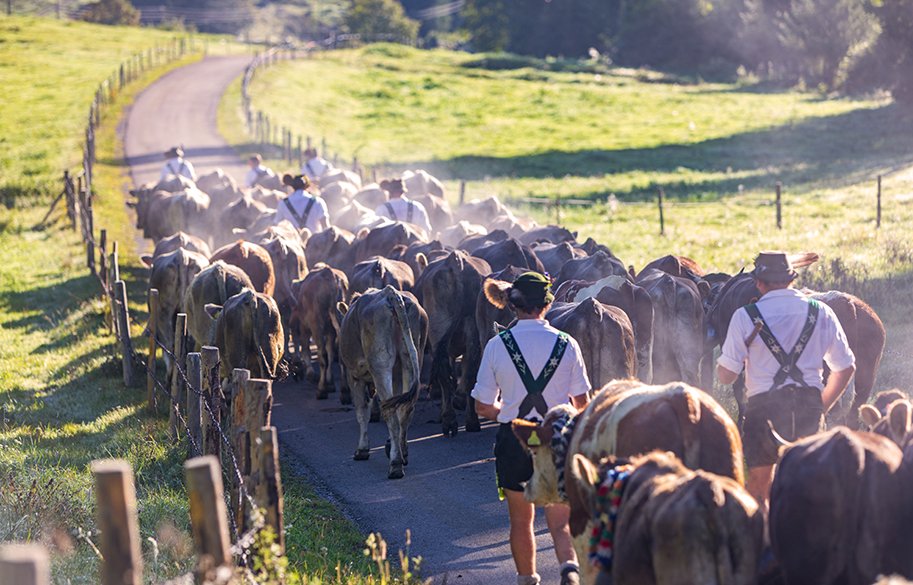
Every September, all across Austria, Switzerland, Bavaria, and northern Italy, cows come down out of the mountains wearing flower crowns. That’s not a metaphor. Actual cows, actual crowns. Pine branches, paper flowers, sometimes real alpine blooms, all huge and ridiculous and genuinely beautiful. The cows themselves have no idea any of this is coming. They’ve spent the whole summer just eating grass at high altitude. It’s called Almabtrieb, and once you know the rule behind who gets decorated, the whole thing gets even better.
Cows Only Get the Crown If Nobody Died
Here’s the part that surprised me most. The elaborate headdresses aren’t automatic. They’re a reward. If the herd made it through the whole summer up on the alpine pastures without any serious accidents, no animals lost to falls or storms or wolves, the cows get dressed up for the walk back down. If something went wrong that summer, the herd comes down plain. No decorations, no celebration. The parade becomes a visible record of how the season actually went, which is a wild thing to build into a farming tradition.
The whole thing is a form of what’s called transhumance, moving livestock seasonally between low winter pastures and high summer ones. Every spring, farmers walk their cattle up into the mountains, sometimes above 3,000 feet, chasing richer grass and longer grazing. That upward trip has its own name, Almauftrieb, though these days farmers mostly do it by trailer instead of on foot. The walk back down each fall is the one everyone still does the old way. That’s Almabtrieb, and it’s the one that turned into a full-blown celebration.
Bells, Not Just for Show
Along with the flowers, the cows wear enormous bells, sometimes strapped to leather collars engraved with phrases like “Gott schütze uns,” God protect us. The bells aren’t purely decorative either. Historically they served a real function. If a cow wandered off from the herd somewhere in the mountains, the sound helped the farmer find her. Some accounts trace the ringing even further back, to an old belief that the noise warded off evil spirits on the way down. Practical reasons and superstitious ones, stacked on top of each other. That’s basically how most old traditions end up working.
Every region in the Alps decorates a little differently. Around Imst and Landeck in Tyrol, you’ll see masks covered in small mirrors and painted sayings. In East Tyrol and the Ausserfern, it’s more about wreaths of fir and alpine flowers. Each valley, sometimes each individual farm, carries its own signature look, one families have handed down for generations. Locals can apparently tell at a glance which farm a decorated cow belongs to, just from the style.
Older Than You’d Guess
The tradition itself is genuinely old. Alpine dairy farming, moving herds up to summer pastures and back, has shaped the landscape of the Alps for centuries. Without it, most of the lush green slopes below about 6,000 feet would just be dense forest instead of open meadow. Written references to decorated cows specifically go back to the mid-1700s in Tyrol. The underlying custom of the seasonal cattle drive runs considerably older than that.
It’s also, quietly, becoming rarer. The number of alpine farmers in Switzerland alone dropped by close to 75 percent over the course of the 20th century. Walking a herd for miles down a mountain, decorating every animal by hand, organizing an entire village celebration around it: that’s a lot of work for a shrinking number of people to keep doing. The farmers who still do it tend to describe it less as an obligation and more as something close to pride, in the animals and in a way of life that’s slowly disappearing around them.
Recent Podcast Episodes

Recent Adventures



Subscribe Today!
Subscribe
Your Ad Here!

Other Adventures You May Like

Nils Olav, the Penguin the Norwegian Army Keeps Promoting

A Guide to Caravan Sales in NSW for First-Time Buyers
