
America’s Roadside Replica Landmarks: Why We Keep Building Copies of Famous Places
An Eiffel Tower stands in a field in Texas. It wears a bright red cowboy hat. Down the road in Tennessee sits another Eiffel Tower, painted red, white, and blue. In Nebraska, builders made a version of Stonehenge entirely out of old cars, spray-painted gray. None of this is an accident. America has been building copies of famous places for over a century, and the reasons turn out to be far more varied than simple novelty.
Sometimes It Starts as a Cover-Up

The Leaning Tower of Niles sits just outside Chicago. Businessman Robert Ilg built it in 1934. His actual goal had nothing to do with tourism. He needed something to disguise a set of water tanks feeding a nearby swimming pool. A half-scale replica of the Leaning Tower of Pisa solved the problem and became a local landmark almost by accident. Niles eventually became a sister city to Pisa itself, adding a plaza and fountain to make the relationship official.
Then there’s the rivalry in Texas and Tennessee. Paris, Tennessee built a 60-foot Eiffel Tower first. The town of Paris, Texas responded with its own. Texas topped its tower with an oversized cowboy hat, specifically to make sure it stood taller than Tennessee’s. Neither town seemed particularly concerned with historical accuracy. Both seemed very concerned with winning.
Sometimes It Starts as a Joke
Foamhenge appeared in Virginia on April Fool’s Day, 2004. Artist Marc Cline built it as a prank, a full-size Stonehenge replica made entirely of styrofoam. It was supposed to be temporary and silly. Instead it became a genuine roadside attraction. Cline reportedly built it with real astronomical alignment, matching the solstice orientations of the original stones in Wiltshire.
Carhenge, in Alliance, Nebraska, took a similar spirit further. Builder Jim Reinders arranged 38 vintage American cars into the shape of Stonehenge in 1987. He painted every one flat gray to mimic ancient stone. A similar structure called Truckhenge exists in Topeka, Kansas, built from old trucks instead. Neither pretends to be historically serious. Both draw steady crowds anyway.
Sometimes It’s Actually a Memorial
Not every replica is a punchline. The oldest American Stonehenge replica sits on a bluff above the Columbia River in Maryhill, Washington. Sam Hill, a wealthy railroad executive and committed pacifist, built it in the early 20th century. Hill mistakenly believed the original Stonehenge had once been the site of human sacrifice. He built his replica specifically as a memorial to the soldiers of Klickitat County who died in World War I. He intended it as a permanent reminder that humanity was still, as he put it, being sacrificed to the god of war. The historical premise was wrong. The intention behind it was entirely serious.
Sometimes It Isn’t Even a Replica
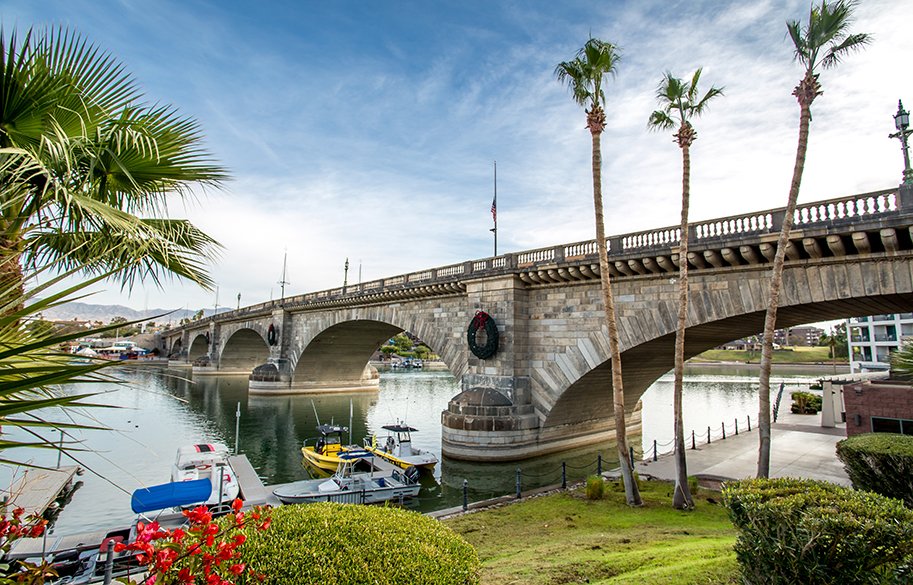
And finally, Lake Havasu City, Arizona took a different approach entirely. Rather than build a copy of London Bridge, the city bought the real one. The original bridge had become unsuitable for London’s growing traffic, so in 1968 the city purchased it for $2,460,000. Workers dismantled the bridge stone by stone, shipped the pieces to Arizona, and rebuilt it over a manufactured canal. It reopened in 1971, an authentic 19th-century London landmark standing in the middle of the Arizona desert.
Recent Podcast Episodes

Recent Adventures



Subscribe Today!
Subscribe
Your Ad Here!

Other Adventures You May Like

Nils Olav, the Penguin the Norwegian Army Keeps Promoting

The Mount Washington Cog Railway Has Been Climbing New Hampshire’s Tallest Peak Since 1869
