
Artemis II: Inside NASA’s First Crewed Flight Around the Moon Since 1972
Nobody had traveled this far from Earth in more than fifty years. On April 1, 2026, four astronauts lifted off from Kennedy Space Center. Over the following ten days, they flew around the Moon and safely back home, the first human beings to make that trip since the final Apollo mission in 1972.
Four Astronauts, One Very Long Rollout
The crew for Artemis II included NASA astronauts Reid Wiseman, Victor Glover, and Christina Koch, along with Jeremy Hansen of the Canadian Space Agency. Before any of them ever left the ground, their actual spacecraft had already made its own slow journey. NASA’s SLS rocket, carrying the Orion capsule, rolled roughly four miles from its assembly building to the launch pad. That trip alone took about 12 hours from start to finish. The rocket had a reputation for temperamental behavior even before that, having triggered more than one launch-attempt-ruining fuel leak during earlier testing.
Launch finally came at 6:35 p.m. Eastern time on April 1, 2026, from Launch Complex 39B in Florida. Four astronauts rode the SLS rocket, NASA’s most powerful launch vehicle to date, off the pad and into orbit. Officials described it as the first crewed lunar flyby in more than 50 years.
Ten Days Around the Moon and Back
Artemis II was never designed to land. This was a flyby mission, meant to send the crew looping around the Moon and back to Earth over roughly ten days. Along the way, it would test the Orion spacecraft’s life support systems with actual people aboard for the very first time. On April 2, the crew completed a critical maneuver called translunar injection, a five-minute engine burn that set their course toward the Moon. From their windows, they captured striking images of Earth. Two auroras glowed near the poles. Zodiacal light hung faintly visible in the background. Venus sat quietly in the corner of the frame.
Life aboard settled into an unusual rhythm almost immediately. The crew slept in split cycles, four hours at a time, waking partway through to adjust Orion’s orbital path before returning to rest. Once everyone was up again, Wiseman became the first crew member to use the spacecraft’s onboard exercise equipment. Christina Koch described the experience of watching Earth from that distance as something genuinely impossible to prepare for. The planet appeared lit bright as day on one side, she said, and glowing softly with moonlight on the other. The view left her even more eager for what was coming next. Soon she’d see the Moon itself up close, something no living astronaut had experienced in over five decades.
The Far Side, Then the Hardest Part
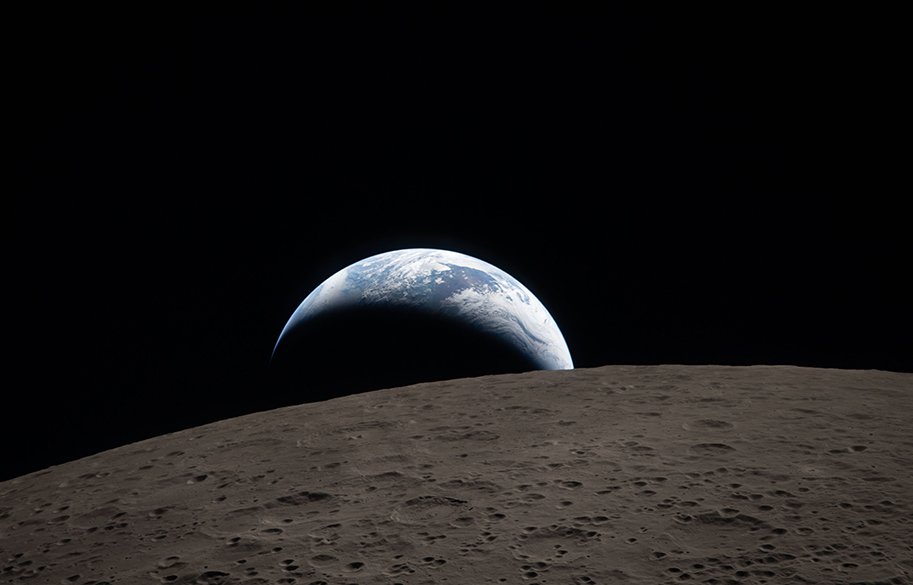
On April 6, the crew swept around the far side of the Moon, out of direct radio contact with Earth for a stretch of the journey. They photographed Earth setting over the Moon’s curved horizon. The images captured lunar features like the Orientale Basin and the concentric rings of the Hertzsprung Basin, interrupted by the younger crater Vavilov sitting on top of much older terrain.
Getting home safely was, by most measures, the most dangerous part of the entire mission. Orion reentered Earth’s atmosphere at roughly 25,000 miles per hour, generating heat around 5,000 degrees Fahrenheit against its heat shield. That shield mattered enormously. During the earlier uncrewed Artemis I test flight, engineers had noticed unexpected cracking and charring on the same type of heat shield. Resolving that concern became a critical part of clearing Artemis II to fly with an actual crew aboard.
Why NASA Didn’t Just Go Straight to the Surface
The SLS rocket that carried Artemis II into space offers more payload mass, volume, and departure energy than any other single rocket ever built. Engineers purpose-designed it to eventually carry astronauts and equipment all the way to a lunar landing. NASA still chose to fly a proving mission first rather than aim straight for the surface. That caution traces directly back to the Apollo program’s own history. Apollo 8 circled the Moon in 1968 without landing, a full year before Apollo 11 finally put boots on the surface in 1969.
Artemis II followed that same basic logic more than half a century later. Prove the spacecraft works. Prove the life support systems work. And also prove the navigation works, all with real people aboard, before betting an actual landing attempt on any of it. A flyby mission generates less spectacle than a landing does. It generates considerably more data about exactly what still needs fixing before anyone risks a landing at all.
Splashdown, and What Comes Next
At 8:07 p.m. Eastern time on April 10, 2026, Orion splashed down in the Pacific Ocean off the coast of San Diego. Eleven parachutes slowed the capsule’s descent to a gentle 17 miles per hour at the moment of impact. Helicopters retrieved all four astronauts and flew them to the nearby USS John P. Murtha, a Navy transport ship waiting offshore specifically for the recovery. Doctors gave the crew medical evaluations there before the astronauts continued on to NASA’s Johnson Space Center in Houston.
Artemis II proved the hardware and the life support systems could actually carry people safely around the Moon and back. That was always the point. NASA has since adjusted its plans for what happens next. Artemis III, originally intended to land the first woman and the first person of color on the Moon’s south pole, will instead focus on testing a lunar lander in Earth orbit during 2027. The actual crewed lunar landing has moved to Artemis IV, now targeted for 2028. An international space station called Gateway remains in the works too, meant to orbit the Moon and support future missions. Contributions are planned from the European Space Agency, Japan’s space agency, and the Canadian Space Agency.
Recent Podcast Episodes

Recent Adventures



Subscribe Today!
Subscribe
Your Ad Here!

Other Adventures You May Like

The Berners Street Hoax Buried One London Address in Unwanted Deliveries

Nils Olav, the Penguin the Norwegian Army Keeps Promoting
