
Émilie du Châtelet: The Physicist Who Translated Newton and Never Got the Credit
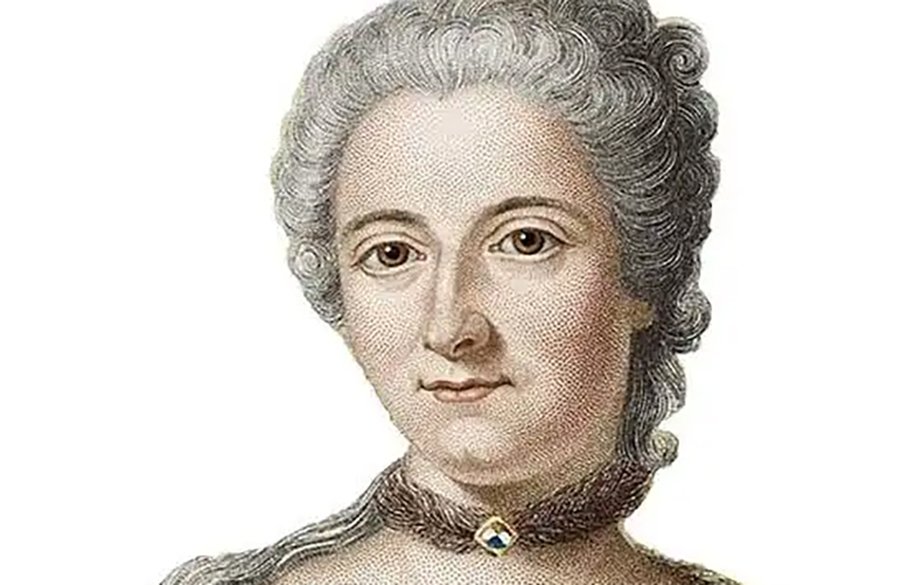
If you read Newton’s Principia in French today, you are almost certainly reading Émilie du Châtelet’s translation. Not a modern one. Hers, finished in 1749, published a decade after she died. It remains the standard French edition of the most important book in the history of physics. She also worked out that the energy of a moving object scales with the square of its velocity. Newton himself had gotten that wrong. Most people have never heard of her. Meanwhile, the best-known thing ever said about her came from Voltaire. It was a compliment, and it has aged into something closer to an insult.
A Noblewoman Who Refused the Assignment
Gabrielle Émilie Le Tonnelier de Breteuil was born in Paris on December 17, 1706, into an aristocratic family. She married the Marquis Florent-Claude du Châtelet-Lomont in 1725, when she was 18, and had three children. That was meant to be the whole story. Eighteenth-century French noblewomen had a defined role, and advanced mathematics was not in it. Universities did not admit women. Scientific academies did not admit women. There was no path into the field. So she built one sideways. She used her family’s money and connections to hire tutors. Then she studied mathematics and physics with an intensity that struck everyone who encountered her.
In 1733 she met Voltaire. He became her lover and, more importantly for this story, her lifelong intellectual partner. They moved to her husband’s estate at Cirey, which they remodeled to include a working laboratory stocked with scientific instruments. Her husband, by most accounts, was fine with the arrangement.
Cirey Became a Research Institution
What happened at Cirey over the following years was serious work, not a hobby. Both of them competed in a 1738 competition run by the French Academy of Sciences on the nature of fire. Du Châtelet entered her own essay independently, without telling Voltaire she had done it. Neither of them won. But the Academy published both entries. So a woman’s scientific paper appeared under her own name in the official proceedings.
Then in 1740, she published Institutions de physique, presented as a physics textbook for her son. It was considerably more than that. The book worked through Newtonian mechanics while supplying a metaphysical foundation for it, drawing on Leibniz and Christian Wolff. So it helped introduce French readers to ideas the Cartesian establishment had resisted. It also dragged her into a public fight.
The Argument About Living Force
The dispute concerned something called vis viva, Latin for living force. It sounds abstract until you see what was actually at stake. The question was how to measure the energy of a moving object. Newton, Voltaire, and most of their contemporaries held that it scaled with velocity. Double the speed, double the force. Leibniz and his followers argued it scaled with velocity squared instead. Du Châtelet sided with Leibniz, and she did not just assert it. Instead, she drew on experiments by the Dutch scientist Willem ‘s Gravesande. He had dropped brass balls into soft clay from different heights, then measured the impressions they left behind.
The results were unambiguous. A ball dropped from twice the height did not leave an impression twice as deep. It left one four times as deep. The energy scaled with the square. Modern physics writes this as kinetic energy equals one half mass times velocity squared. Du Châtelet did not arrive at the modern formula in full. But she got the crucial relationship right, and then defended it against the leading French scientific establishment.
Jean-Jacques Dortous de Mairan, secretary of the Academy of Sciences, attacked her position publicly. She answered him in print. Historians generally judge that she got the better of the exchange. This mattered enormously in the long run. The idea that energy is conserved, and that it relates to velocity squared, sits underneath essentially all of modern physics.
The Coffee House Story
One anecdote captures her situation better than any summary could. Paris had coffee houses where mathematicians and natural philosophers gathered to argue. The Café Gradot was one of the important ones. Du Châtelet wanted in, because that was where the actual conversations happened, and the staff turned her away for being a woman.
So she reportedly had men’s clothing made, walked back in dressed as a man, and sat down. Accounts differ on the details, and the story has been retold enough that some embellishment is likely. But the underlying situation is well documented. She was locked out of nearly every room where science got discussed, and she kept finding ways in anyway.
That’s the context for everything else she accomplished. No university would enroll her. No academy would elect her. Her laboratory existed because she had a wealthy husband with an estate, and her education existed because she could pay tutors directly. Talent alone would not have been enough. Neither would money alone. She needed both, plus a genuinely stubborn refusal to accept the answer she kept getting.
The Principia
Sometime in the early 1740s, she started the project that consumed the rest of her life. Newton’s Philosophiæ Naturalis Principia Mathematica existed only in Latin, which sharply limited who could read it. France remained largely Cartesian, resistant to Newtonian ideas. Du Châtelet set out to translate the entire thing into French.
She did not stop at translation. She also wrote extensive commentary alongside it. That commentary clarified Newton’s mathematical proofs, addressed French objections to his methods, and worked through metaphysical questions his system raised but never answered. She also derived the principle of energy conservation from Newton’s own mechanics, which Newton had not done himself. The result was not a translation in the ordinary sense. It was a translation plus a critical apparatus. Together, those made the book usable to a country that had spent fifty years arguing against it.
She Knew She Was Running Out of Time
In 1748, at 42, du Châtelet became pregnant by the poet Jean-François de Saint-Lambert. She was genuinely frightened. In letters to friends, she confided that she did not expect to survive the birth. Childbirth at that age carried real danger in the eighteenth century. So she worked at a punishing pace to finish the Principia before it happened.
She completed the work in 1749. On the night of September 3, she gave birth to a daughter, Stanislas-Adélaïde. She died on September 10 at Lunéville, from what modern accounts identify as a pulmonary embolism. She was 42. Her daughter died roughly eighteen months later.
Published, Eventually
The Principia translation sat unpublished for years after her death. A portion appeared in 1756 under the direction of the mathematician Alexis Claude Clairaut, with a preface by Voltaire. The complete work followed in 1759. Its title identified it as the work of the late Madame la Marquise du Châtelet. Two hundred and sixty-odd years later, it is still the standard French translation. Nobody has needed to replace it.
The Compliment That Explains Everything
Voltaire wrote to King Frederick II of Prussia about her, and produced the line that follows her through history. He called her a great man whose only fault was being a woman. He meant it warmly. That is what makes it such a precise summary of the problem. Here was the highest praise available to the most famous intellectual in Europe. He was describing the most accomplished scientific mind he personally knew. And it required reclassifying her as a man first.
Her reputation suffered accordingly. For a long time, people remembered her as Voltaire’s mistress who dabbled in science. Almost nobody framed it the other way around, as a physicist who happened to live with Voltaire. He deferred to her on technical matters and said so, but the framing stuck anyway.
The record itself is not ambiguous. The fire essay is hers. The vis viva argument is hers. The Principia commentary is hers, and French physicists still reach for it. She spent her last months racing to finish a book she suspected she would not live to see published. She was right about that. She was also right about the velocity squared.
Recent Podcast Episodes

Recent Adventures



Subscribe Today!
Subscribe
Your Ad Here!

Other Adventures You May Like

The Berners Street Hoax Buried One London Address in Unwanted Deliveries

Nils Olav, the Penguin the Norwegian Army Keeps Promoting
