
Florida’s Warm Mineral Springs: The Sinkhole That Proved Humans Were in America 11,000 Years Earlier Than Believed
People have been paying to swim in this Florida sinkhole for decades, sold on it as a healing spa, a real-life Fountain of Youth. Almost none of them realized they were floating directly above some of the most important archaeological evidence in North America. The story of how anyone figured that out involves an untrained amateur diver, a human brain that crumbled on live television, and a discovery the scientific establishment initially wrote off as an obvious hoax.
An 85-Degree Sinkhole Nearly 250 Feet Deep
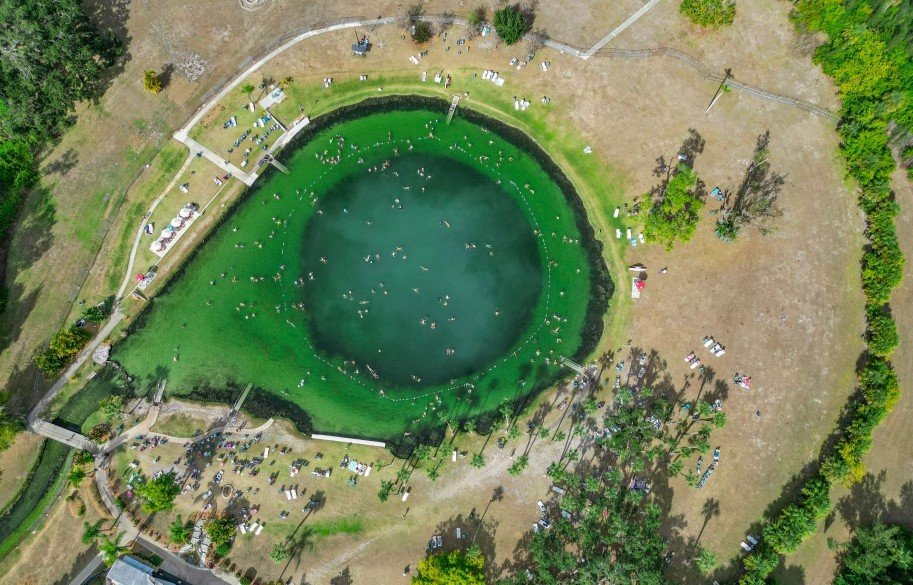
Warm Mineral Springs sits in North Port, Florida, holding steady at 85 to 87 degrees year-round. It carries an estimated 51 different minerals, among the richest mineral content of any natural spring in the country. The surface pond only covers about 1.4 acres, but the hourglass-shaped sinkhole beneath it plunges to nearly 250 feet at its center. Geologists believe an earthquake triggered the original collapse that created it, roughly 20,000 years ago.
About ten miles away sits its sister site, Little Salt Spring, an even larger sinkhole now owned by the University of Miami as a protected research preserve. Unlike Warm Mineral Springs, nobody swims there casually anymore. It’s an active dig site, not a public pool.
An Amateur Diver Finds Something the Experts Didn’t Believe
In 1959, an amateur diver named William Royal, working alongside shark researcher Eugenie Clark, brought up human bones from at least 30 different individuals across both springs. A partially burned log found near some of the remains got radiocarbon dated to roughly 10,000 years old. If the bones matched that age, Royal had just found the oldest confirmed evidence of human presence in Florida.
Then things got genuinely strange. While brushing dirt off one of the recovered skulls for television cameras, Royal accidentally uncovered a human brain. It had been naturally preserved inside the skull for thousands of years. It disintegrated almost immediately once exposed to air. The timing could not have looked worse. An untrained diver, filming for television, stumbled onto an anatomically improbable, perfectly preserved brain at the exact moment the cameras were rolling. Professional archaeologists largely dismissed the entire find as a hoax. That wasn’t because the evidence itself was weak. It was because the whole scene sounded too dramatic to be real.
Twelve Years of Proving It Wasn’t Fake
Royal didn’t stop diving. For the next twelve years, he kept returning to both springs, pulling up more artifacts and human remains. He was trying to get credentialed archaeologists to actually look at what he’d found. Seven years after the initial discovery, the specific skeleton connected to that crumbling brain finally got properly carbon-dated. It came back at somewhere between 7,140 and 7,580 years old. That’s genuinely ancient, even if not quite as old as the burned log had initially suggested. Later, more formal excavations, led by archaeologist C. Clausen, confirmed and expanded on nearly everything Royal had spent over a decade insisting was real.
Part of the Evidence That Finally Broke an 80-Year-Old Theory
For roughly 80 years, American archaeology largely operated under something called the Clovis First model. The belief held that a culture dated to about 13,000 years ago represented humanity’s actual first arrival in the Americas. Sites like Warm Mineral Springs chipped away at that theory. A related Florida site, Page-Ladson, along the Aucilla River, helped finish the job. Michael Waters directs the Center for the Study of the First Americans at Texas A&M University. He’s stated plainly that Page-Ladson provides unequivocal evidence of human occupation predating Clovis by more than 1,500 years.
Accumulated archaeological and genetic evidence since then has made the picture even clearer. Multiple sites across North and South America now point to people living in the Americas by at least 15,000 years ago. That conclusion is increasingly backed by studies of both modern and ancient human genomes. The Clovis First model, dominant for eight decades, simply doesn’t hold up against the evidence anymore.
Royal’s diving partner deserves her own mention too. Eugenie Clark went on to become one of the most respected marine biologists of the 20th century. Pioneering research into shark behavior earned her the nickname “the Shark Lady.” Her presence on that 1959 dive wasn’t incidental. It lent the discovery real scientific credibility, even if it still wasn’t enough to overcome the skepticism that followed.
This isn’t a closed chapter of archaeology, either. The University of Miami has hosted full academic conferences specifically dedicated to Little Salt Spring’s significance. Those gatherings bring together researchers from multiple universities, the Florida Public Archaeology Network, and the Seminole Tribe of Florida. Work at both springs continues decades after Royal’s initial dives. Researchers still hold out hope that these two sinkholes have more to say about who actually lived in Florida first, and when.
A Natural Time Capsule for the Ice Age
The springs preserved more than just human remains. Divers have recovered bones from saber-toothed tigers, giant ground sloths, giant tortoises, and even camels. These were animals that once roamed a Florida landscape almost unrecognizable today. At Little Salt Spring specifically, researchers found a wooden stake dating back roughly 12,000 years, among the oldest such artifacts found anywhere in the southeastern United States.
The preservation comes down to the water itself. Deep down, it turns salty and almost entirely oxygen-poor. Those conditions slow decomposition dramatically, keeping organic material intact for thousands of years in a way ordinary dry-land burial sites simply can’t match.
The spring earned a spot on the National Register of Historic Places in 1977. It’s still open to the public today, though strict rules now prohibit diving or disturbing the bottom. That’s a direct concession to the archaeological site sitting beneath the swimmers. Little Salt Spring remains closed to casual visitors entirely. It’s still an active research site more than 65 years after an amateur diver and a television crew stumbled onto evidence nobody was ready to believe.
Recent Podcast Episodes

Recent Adventures



Subscribe Today!
Subscribe
Your Ad Here!

Other Adventures You May Like

The Berners Street Hoax Buried One London Address in Unwanted Deliveries

Nils Olav, the Penguin the Norwegian Army Keeps Promoting
