
Green Bank, West Virginia: The Town Where WiFi Is Actually Illegal
A kid in Green Bank, West Virginia, once hacked a teacher’s computer to build a WiFi hotspot. School officials weren’t just annoyed about the hacking. The 13-year-old had also broken state law. That’s not an exaggeration. For decades, WiFi in Green Bank genuinely violated the West Virginia Radio Astronomy Zoning Act. Nobody wrote that law to punish teenagers. They wrote it to protect one very large, very sensitive piece of equipment.
A 485-Foot Reason for the Silence
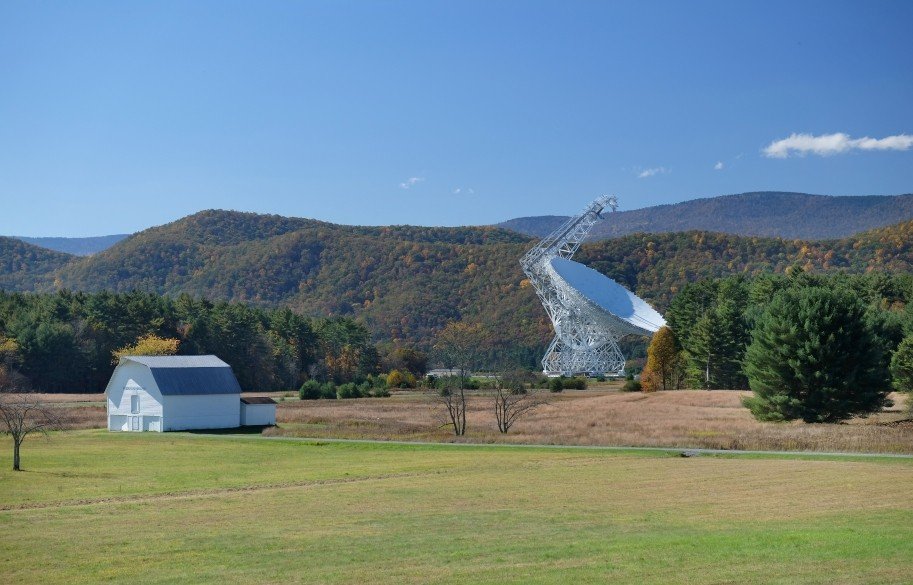
Green Bank sits inside the National Radio Quiet Zone. The federal government set aside this 13,000-square-mile stretch of West Virginia and Virginia back in 1958. Restrictions apply across the whole zone, but they tighten hard around one specific target: the Robert C. Byrd Green Bank Telescope.
The telescope stands 485 feet tall. It holds the record for the largest fully steerable radio telescope on Earth. It listens for signals so faint that an ordinary WiFi router can drown them out completely. Astronomers compare the setup to needing total darkness for an optical telescope. Here, the darkness has to be electromagnetic.
State law backed the science up. Inside the tightest ring around the observatory, the West Virginia Radio Astronomy Zoning Act banned radio interference strong enough to disrupt the telescope. That covered WiFi. It covered cell signals too. That’s why cell service in Green Bank still sits at essentially zero.
The Town That Attracted People Fleeing Signals
Green Bank counts somewhere between 150 and 200 year-round residents. For years, it doubled as a genuine refuge for a specific kind of person. People who call themselves electrosensitive believe WiFi and cell signals make them physically ill. Some of them packed up and moved to Green Bank specifically because the town couldn’t legally have any. Longtime locals didn’t always welcome the newcomers. The town became an odd little mix anyway, generations-old families living next to people who’d relocated hundreds of miles chasing silence.
Author Stephen Kurczy spent real time in Green Bank researching his book “The Quiet Zone.” He wrote about a student named Bond who faced a possible $50 fine for that WiFi hotspot. The same day, a teacher caught Bond passing his girlfriend a paper note. Old-fashioned trouble and new-fashioned trouble, both in one afternoon.
Emergency Responders Hated It
Not everyone found the arrangement charming. Emergency officials in the surrounding counties spent years fighting the restrictions, and they had a genuinely strong case.
Police and firefighters need wireless communication just like everyone else. In a real emergency, hunting down a landline isn’t a quirky inconvenience. It’s a real risk. Pendleton County’s Emergency Services Coordinator, Rick Gillespie, put it bluntly to reporters. Wireless connection had become a lifeline for public safety, he said, not just a convenience.
The observatory even employs someone to enforce the rules directly. Staff sometimes call this person the radio policeman. Their job involves literally driving around with detection equipment, hunting down rogue signals bleeding out of microwaves, baby monitors, and the occasional forbidden router.
The Ban Actually Lifted, Recently
Something finally changed. In December 2025, officials rewrote how they enforce the rules inside the 10-mile radius closest to the observatory. WiFi could now legally operate there, running on the 2.4 GHz band for the first time. Green Bank Elementary Middle School got access too, the same school where a kid once faced a fine over a hotspot. Its students had been the only ones in the county without WiFi at all.
The larger 13,000-square-mile Quiet Zone hasn’t gone anywhere. The observatory still needs genuine electromagnetic silence to do its job. Cell service in town remains close to nonexistent. But the strictest version of the ban, the one that turned ordinary school WiFi into a legal violation, finally eased after roughly seven decades.
Recent Podcast Episodes

Recent Adventures



Subscribe Today!
Subscribe
Your Ad Here!

Other Adventures You May Like

The Berners Street Hoax Buried One London Address in Unwanted Deliveries

Nils Olav, the Penguin the Norwegian Army Keeps Promoting
