
Loki’s Castle: The Deep-Sea Vent Field Named After a Norse Trickster God
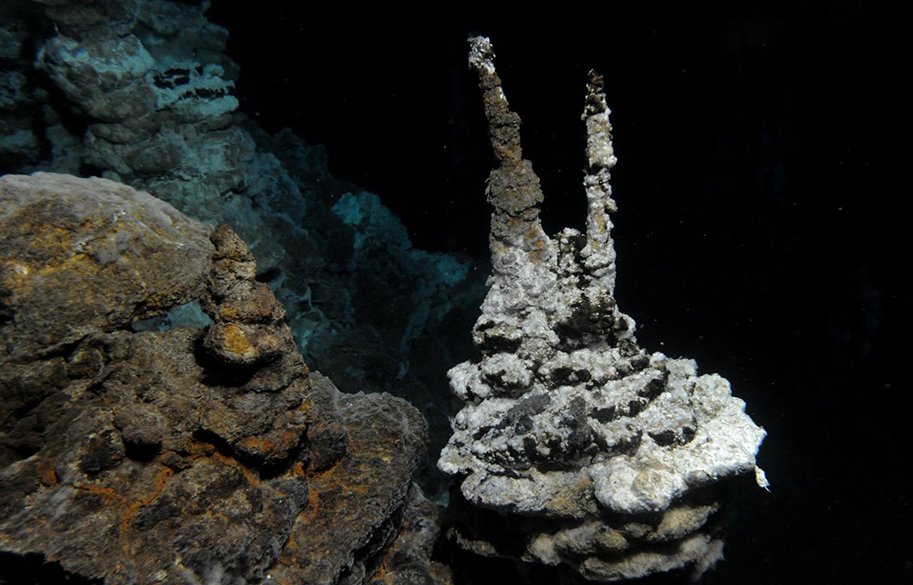
Nearly 7,500 feet below the freezing waters between Greenland and Norway, a cluster of volcanic chimneys spews out superheated, mineral-rich water into total darkness. Scientists named it Loki’s Castle, after the Norse god of trickery. They picked that name on purpose, since the site had been genuinely difficult to track down. Turns out that name fit even better than they realized. This place would go on to hide one of the biggest clues yet toward answering how complex life on Earth actually began.
A Genuinely Hard Place to Find
A 25-person team from the University of Bergen discovered the vent field in 2008, led by geologist Rolf Pedersen. At the time, it was the most northerly black smoker vent system ever found. It sat more than 120 nautical miles north of the previous record holder. So the researchers had good reason to name it after a trickster god. This particular patch of ocean floor didn’t want to be found.
The site sits on the Gakkel Ridge, roughly 2,300 meters down. That’s a stretch of Earth’s crust that’s actually quite geologically calm. Fewer tectonic forces usually mean fewer hydrothermal vents form at all. But Loki’s Castle exists anyway, which already made it something of an anomaly before anyone even looked closely at what lived there.
The Chimneys Got Their Own Names Too
Four main chimney structures make up the field, and the researchers gave each one its own personality. One, on the eastern mound, got named João. The others, clustered on the western mound, ended up called Menorah, Camel, and Sleepy. It’s a strange kind of whimsy for a place buried under thousands of feet of freezing, pitch-black ocean.
Despite the hostile setting, life thrives there anyway. Dense mats of bacteria coat the vents, living entirely off the hydrogen and sulfur compounds the chimneys constantly release. A recent survey of the site’s fauna found five newly identified species, with another ten still waiting on formal description. So even now, more than fifteen years after discovery, scientists are still finding things down there they’ve never seen before.
Then Came the Discovery That Actually Mattered
In 2010, researchers pulled a sediment core from near the vent field. They found DNA belonging to a completely unknown microbe. They named it Lokiarchaeota, after the site where it turned up. What made it significant wasn’t just the name, though. Its genes looked partway between ordinary single-celled microbes and the vastly more complex cells that make up every plant, animal, and fungus on Earth. Yes, that includes us.
That’s a genuinely huge deal in biology. Scientists have spent decades trying to figure out how complex cellular life, called eukaryotic life, ever evolved out of simpler organisms in the first place. Still, nobody had a clear answer. Researcher Anja Spang, one of the study’s lead authors, said Loki shares genes uniquely with eukaryotes. That, she said, suggests cellular complexity emerged surprisingly early in that evolutionary story. In other words, this tiny microbe pulled from freezing Arctic mud might represent an actual missing link.
Proving It Took Nearly Six Years of Patience
Early doubts lingered for years, since the original evidence came from genetic sequencing alone, not an actual living sample. Maybe the core got contaminated somewhere along the way. Nobody could fully rule that out. So a team of Japanese researchers set out to grow Lokiarchaeota directly in a lab. They used a bioreactor to slowly enrich the right conditions from anaerobic, methane-rich sediment. That process took 2,000 straight days, just over five and a half years, before they finally succeeded.
Their success confirmed the organism was real, not contamination. It also helped establish an entirely new group of archaea, the Asgard superphylum, continuing the same Norse mythology naming scheme even further. A vent field named after a trickster god ended up housing a genuinely honest answer to one of biology’s oldest open questions. Loki, it turns out, was hiding something real this whole time.
Recent Podcast Episodes


Recent Adventures


Subscribe Today!
Subscribe
Your Ad Here!

Other Adventures You May Like

The Kailasa Temple Was Carved Downward Out of One Piece of Rock

Vesna Vulović Fell 33,000 Feet Without a Parachute and Lived
