
Operation Popeye: The Vietnam War Program That Tried to Weaponize Rain
For five years, American pilots flew classified missions over Southeast Asia with one of the strangest objectives in military history. They were trying to make it rain. Not metaphorically, and not as some fringe proposal that died in a planning meeting either. This was a real program, it ran from 1967 to 1972, and when the public finally found out about it, the backlash produced an international treaty that still stands today.
The Jungle Was Winning
By the mid-1960s, the U.S. had a problem it couldn’t bomb its way out of. North Vietnamese troops and supplies kept flowing south along the Ho Chi Minh Trail, which wasn’t really a road so much as a sprawling web of jungle paths winding through Laos and Cambodia. Bombing campaigns hit it. Ground operations tried to cut it. The jungle just absorbed all of it and kept going.
So somebody in a planning room asked a question that sounds unhinged until you sit with it for a second. What if you didn’t need to destroy the roads at all? What if you could just make it rain so relentlessly that the roads turned to soup on their own?
The Science Already Existed, Which Is the Unsettling Part
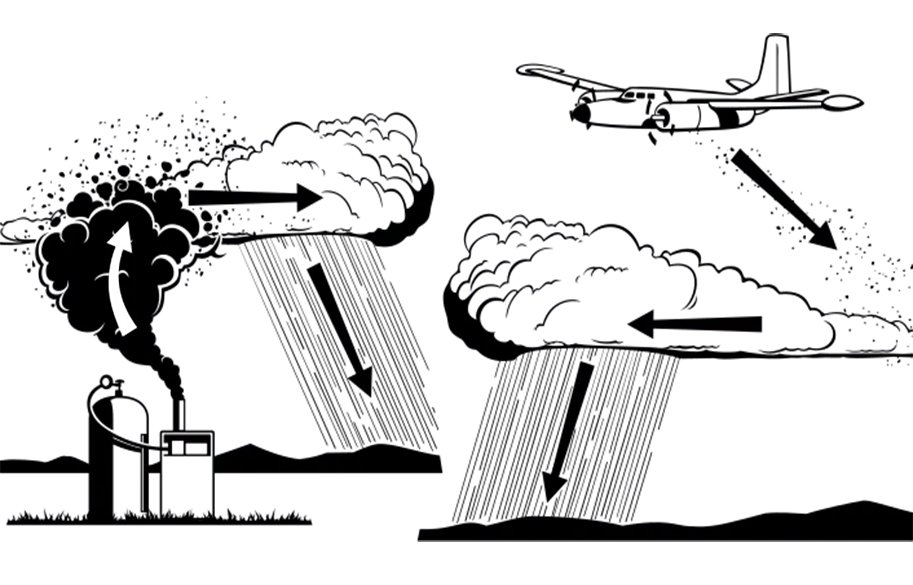
Cloud seeding wasn’t some experimental long shot. Researchers had been messing with it since the 1940s, including civilian projects aimed at weakening hurricanes. The basic idea is almost disappointingly simple. Drop silver iodide into a cloud that’s already heavy with moisture, and those particles give water droplets something to form around. More droplets, more rain.
What made Operation Popeye different is that nobody had ever aimed it at an enemy before. U.S. planes flew out of a Thai air base on missions logged as “weather reconnaissance,” which was technically true in the way a getaway driver is technically just driving. The crews were actually dropping flares packed with silver and lead iodide straight into storm systems over Laos, Cambodia, and Vietnam. Over five years, they flew more than 2,600 sorties and released around 47,000 flares, at a cost of roughly $15 million.
It Worked. That Wasn’t Enough.
Here’s what surprises most people: the thing actually did something. Declassified reports later showed rainfall jumping 30 percent or more in seeded areas. Stretches of the trail genuinely turned to mud. Convoys slowed down, landslides buried sections of road, and internal assessments confirmed the extra water was making life measurably harder for North Vietnamese logistics.
But you can’t aim weather with any precision, and the people on the receiving end weren’t passive about it. They rerouted. They repaired. And they adapted faster than the rain could accumulate. So Popeye succeeded as a science experiment and failed as a weapon, which is a genuinely strange thing for a five-year military program to end up being.
The Secretary of Defense Found Out With Everyone Else
The secrecy is where this gets almost comic. Leaks started surfacing in 1971, then the story broke wide open in 1972 through Jack Anderson’s columns and reporting in the New York Times. The Pentagon Papers referenced it too.
Then came Senate hearings in 1974, and the whole thing unraveled properly. Secretary of Defense Melvin Laird had already testified to Congress that no such weather program existed. He hadn’t lied, as it turned out. Nobody had told him. Investigators eventually traced the operation back to Henry Kissinger and the CIA, running it well outside the official chain of command, and somehow skipping the guy nominally in charge of the entire military.
The Rule It Accidentally Created
Public outrage moved fast after that, and the U.S. did something a little unexpected. It approached the Soviet Union about banning weather warfare outright, which is a bold move for the country that had just been caught doing it. The resulting treaty cleared the United Nations in 1976 and took effect in 1978. It’s called the Environmental Modification Convention, and it bars any hostile use of environmental manipulation that could cause serious, lasting harm.
Worth noting, though, that ban only covers military use. China now runs the largest cloud seeding program on the planet, generating billions of tons of rain a year for drought relief and agriculture, completely legally. Same core technology, same silver iodide, entirely different intent. Turns out the problem was never really the rain.
Recent Podcast Episodes

Recent Adventures



Subscribe Today!
Subscribe
Your Ad Here!

Other Adventures You May Like

The Berners Street Hoax Buried One London Address in Unwanted Deliveries

Nils Olav, the Penguin the Norwegian Army Keeps Promoting
