
Ota Benga: The Congolese Man Displayed in the Bronx Zoo in 1906
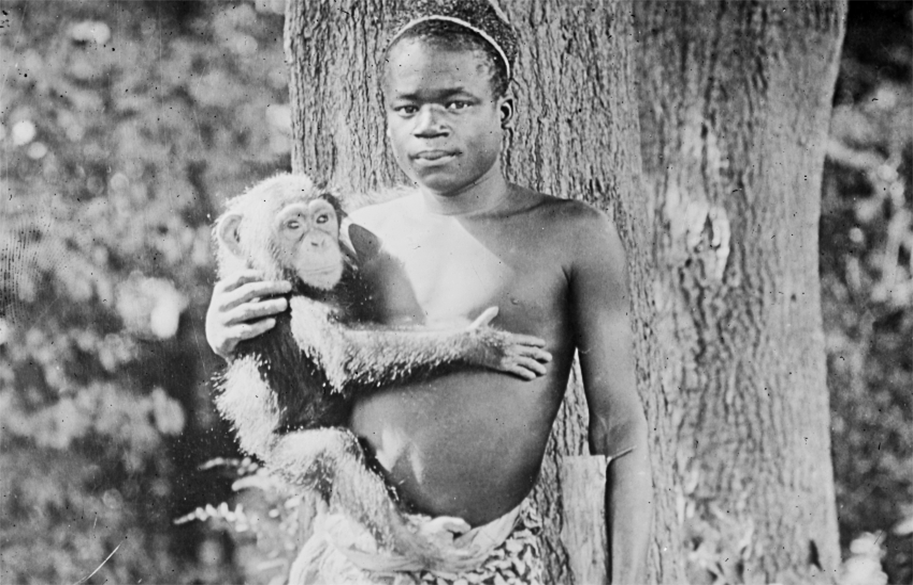
In September 1906, visitors to the Bronx Zoo walked past a sign posted on one of the cages in the Monkey House. It listed an age of 23. A height of 4 feet 11 inches. A weight of 103 pounds. It noted the Kasai River in the Congo Free State as a place of origin, and named the man who had brought him. Inside that cage was a person. His name was Ota Benga.
He Had a Life Before Any of This
Ota Benga was born around 1883 and belonged to the Mbuti people of what is now the Democratic Republic of Congo. Europeans of the era called his people “pygmies,” a label applied from the outside and used mainly to categorize rather than describe. He had filed teeth, sharpened to points. That was a customary practice among young men in his forest-dwelling community, an ordinary part of growing up there. American audiences would later hear it meant something else entirely.
What happened to his family remains genuinely difficult to establish. Most surviving accounts came from the men who displayed him, not from Benga himself. What’s documented is that in 1904, an American named Samuel Phillips Verner purchased him from slave traders.
He Was Brought to America as an Exhibit
Verner worked as a missionary, an anthropologist, and a businessman. The Louisiana Purchase Exposition had contracted him to travel to Africa and bring back people to display at the 1904 World’s Fair in St. Louis. That was the actual job description.
Verner’s own writings make his views hard to misread. On his first voyage to the Congo, he wrote to his mother, describing his dismay at seeing dark-skinned passengers dining alongside white passengers. So the man who brought Ota Benga to America already held the beliefs that would define how Benga got treated there.
At the St. Louis fair, organizers displayed Benga alongside other Africans in an anthropology exhibit. The framing wasn’t subtle. Fairgoers came to look at human beings presented as evidence of a supposed racial hierarchy. That fit a broader nineteenth-century enthusiasm for ranking human populations against each other.
After the exposition ended, Verner returned Benga to the Congo. Benga stayed for a while with the Batwa people. Then he chose to travel back to the United States with Verner again. That decision remains genuinely hard to interpret today, given how little of his own account survives.
He Was Not the Only One
It’s worth understanding that Ota Benga’s case wasn’t an isolated act of cruelty by one strange zoo director. Human displays like this had a whole infrastructure behind them across Europe and America in the late 1800s and early 1900s.
World’s fairs regularly featured “living exhibits” of people brought from colonized regions. Organizers built villages on fairgrounds and installed families inside them. Visitors paid admission and walked through. Scientific societies of the era treated these displays as legitimate research material, not entertainment. That’s part of what gave the whole practice its respectability.
That context doesn’t soften what happened to Benga. If anything, it makes it worse. He wasn’t the victim of one man’s cruelty. A whole system processed him, and saw nothing unusual about doing it. That held right up until a group of ministers in New York refused to accept it.
The Monkey House
Verner first arranged for Benga to stay briefly at the American Museum of Natural History in Manhattan. Then, in 1906, he presented him to Bronx Zoo director William Hornaday. Hornaday put him in the Monkey House. Starting the week of September 8, 1906, the zoo exhibited Ota Benga each afternoon, sharing space with an orangutan named Dohong. Staff scattered bones across the cage floor. That detail was deliberate, meant to suggest cannibalism to visitors, using his filed teeth as supposed corroboration.
Crowds came immediately. The New York Times ran a headline the next morning describing a “bushman” sharing a cage with the park’s apes. Accounts from the time describe him alternating between standing silently and shooting a bow and arrow. Sometimes he angrily mimicked the jeering of the people watching him. He was 23 years old.
The exhibit did not last long, and the reason it ended matters. A group of Black clergymen in New York organized against it immediately and forced the zoo to stop. One of them, the Reverend James Gordon, went further. He arranged for Benga to leave the zoo entirely and stay at an orphanage he directed in Weeksville, Brooklyn. Those ministers acted in 1906, while the display was still running. They pushed back against a zoo director and an institution with real public standing.
The Years After
Benga eventually moved to Lynchburg, Virginia. He worked in a tobacco factory there. He learned English. People who knew him there described a man trying to build an ordinary life. This was in a country that had put him in a cage.
He wanted to go home. Returning to the Congo required money and passage he could not arrange on his own. Then World War I broke out, and closed off the possibility almost entirely. Ships weren’t crossing. The route home effectively disappeared. In 1916, Ota Benga died by suicide. He was 33 years old. He went into an unmarked grave.
An Apology, 114 Years Later
For most of the following century, the Bronx Zoo said very little about any of it. A 1992 book by Phillips Verner Bradford and Harvey Blume brought the story to a wider audience. Journalist Pamela Newkirk later published her own extensively researched account, digging into records the institution itself had never fully addressed.
Then, on July 29, 2020, the Wildlife Conservation Society, which runs the Bronx Zoo, issued a formal public apology. The statement named him directly. It condemned the treatment of a young Central African man from the Mbuti people. It stated his name plainly. And it acknowledged that zoo officials, led by Hornaday, had put him on display. It credited the Black ministers whose outrage ended the exhibit. It stated that, robbed of his humanity and unable to return home, he took his own life a decade later.
The organization framed the apology as part of confronting its own historic role in promoting racial injustice. Not everyone found it sufficient. Harvey Blume, who co-authored the 1992 book, responded bluntly when asked about it. He pointed out the obvious problem with the timing, noting that it arrived rather late for Ota himself.
Recent Podcast Episodes

Recent Adventures



Subscribe Today!
Subscribe
Your Ad Here!

Other Adventures You May Like

The Berners Street Hoax Buried One London Address in Unwanted Deliveries

Nils Olav, the Penguin the Norwegian Army Keeps Promoting
