
Sky Burial: Tibet’s Funeral Tradition and the Reasoning Behind It
In much of Tibet, when someone dies, their body doesn’t get buried or cremated. It gets carried up a mountain, laid out in the open, and left for vultures. Tibetans call the practice jhator, which translates roughly to “giving alms to the birds.” The term “sky burial” actually came from outsiders, and it’s stuck in the West ever since, even though nothing about the ritual involves burying anything at all.
Why Tibetans Actually Do This
The reasoning traces back to Vajrayana Buddhist belief. Once someone dies, Tibetan Buddhists consider the body an empty vessel, since the soul has already moved on toward rebirth. Offering that vessel to vultures counts as a genuine final act of generosity. It’s one last chance to be useful to other living beings before it’s gone for good.
There’s an origin story behind it too. One of the Jataka tales describes a past incarnation of the Buddha, Prince Sattva. He came across a starving tigress who couldn’t feed her own cubs. Moved by compassion, he offered his own body so she could survive. Tibetan Buddhists see sky burial as following that same example.
Practical realities matter here as well, and they’re not small ones. Much of the Tibetan plateau sits on frozen, rocky ground, which makes digging a grave genuinely difficult most of the year. Wood for cremation has always been scarce at that altitude too. Sky burial solves both problems at once.
What Actually Happens
After someone dies, the body stays at home for three to five days, wrapped in white cloth. Monks read scripture aloud during that time to help the soul on its way. Family members then carry the body to a designated site, sometimes with drumming and chanting along the way. There, specialists called rogyapa, sometimes translated as “body breakers,” burn juniper to draw the vultures in before beginning the actual work.
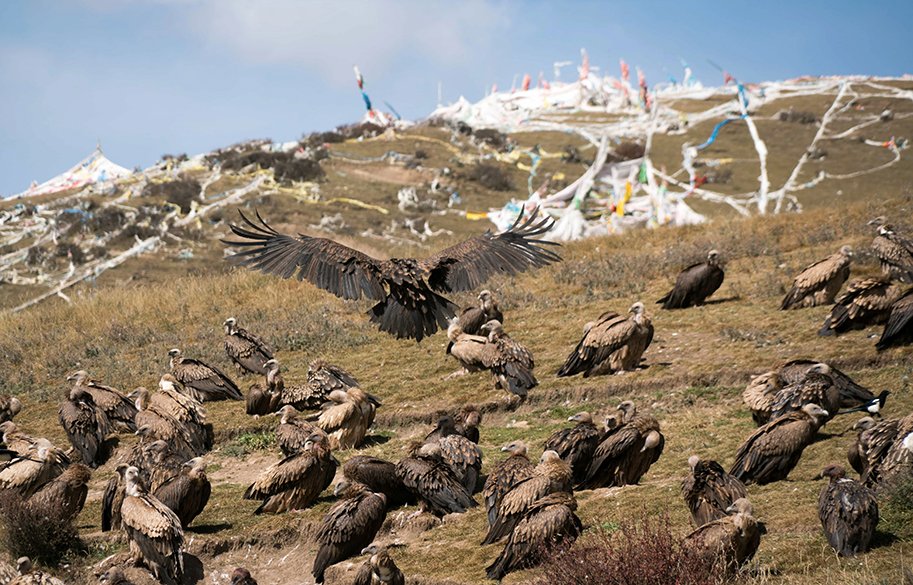
The vultures carry real religious weight in this ritual. Tibetans often call them dakinis, meaning “sky dancers,” and treat them as sacred rather than as scavengers doing something grim. If the birds arrive quickly and eat readily, families take it as a genuinely good sign. It means the deceased carried little sin, and rebirth should go smoothly. If the vultures hold back instead, that reads as a troubling omen, and families sometimes end up cremating whatever’s left as a last resort.
None of this plays out with the grim solemnity you might expect walking in. Rogyapa have described working with a light touch, even cracking jokes during the process. Tibetan Buddhists believe a heavy, sorrowful atmosphere can actually make it harder for the soul to move on.
A Tradition Still Fighting to Continue
Sky burial has roots going back more than a thousand years in Tibet. An Indian monk named Tamba Sanjee reportedly popularized it near the end of the eleventh century. Its future looks considerably less certain now. China banned most religious practice in Tibet after annexing it in 1951, and sky burial stayed officially prohibited through the 1960s and 70s. Tibetans regained limited religious rights in the 1980s. The practice is technically permitted again today, though Chinese authorities have made clear they favor cremation instead.
Recent Podcast Episodes

Recent Adventures



Subscribe Today!
Subscribe
Your Ad Here!

Other Adventures You May Like

The Berners Street Hoax Buried One London Address in Unwanted Deliveries

Nils Olav, the Penguin the Norwegian Army Keeps Promoting
