
Strange Buffalo: Where Folklore, Mystery, and Reality Collide in Western New York
Buffalo has a reputation problem. Most people think of the city as either a punch line about snow and chicken wings, or they don’t think of it at all. But spend a few days there, and you realize Buffalo is actually quite interesting, not despite its weirdness, but because of it. There’s something about Buffalo that attracts the unusual. Maybe it’s the geography, perched on Lake Erie, shaped by the power of Niagara Falls, caught between the industrial past and an uncertain future. Maybe it’s the people, the ones who stayed, who refused to let the city die, who created art and community in the spaces that got left behind. Or maybe it’s something else.
As someone who spends her career investigating folklore, separating myth from reality, and understanding why certain places become repositories of mystery, I have to say that Buffalo is worth the trip. It’s not beautiful in the conventional sense. It’s not a destination you see plastered on Instagram. But it’s genuine. It’s weird. And it’s genuinely worth understanding. Let’s discuss the strangest and most wondrous places in Buffalo, New York.
Eternal Flame Falls: The Fire That Shouldn’t Burn

Somewhere on a cliff face in Chestnut Ridge Park, about 30 minutes south of Buffalo, water falls, and behind the water, a flame burns.
Eternal Flame Falls is exactly what it sounds like: a small waterfall with a natural gas flame burning continuously behind it. The flame has been observed for at least a century, possibly much longer. The Haudenosaunee people (the Indigenous nations of the region) knew about it. Early settlers documented it. And, somehow, it still burns today.
Here’s what makes it genuinely weird: water is falling directly in front of the natural-burning flame. By every law of physics, that flame should go out and stay out. Water and fire are opposites. Yet, there it is. (I will add the addendum, however, that the flame DOES go out sometimes, and it takes a hiker to re-light the gas behind the falls for it to rekindle.)
The science: Natural gas seeps from shale deposits underground. It reaches the surface through cracks in the rock. It collects behind the waterfall. Once you light it (which happens naturally from lightning, or humans have done it historically), it burns. The water falls in front of it, but the gas is behind, protected by the rock overhang. So, the flame persists.
The mystery: The flame is remarkably consistent. It’s been recorded in photographs for over a century in what appears to be roughly the same location. How is the gas flow so stable? There are logical explanations, but standing in front of the flame, watching fire and water coexist, logic feels secondary to wonder.
This is what folklore does: it takes something that has a scientific explanation and asks the deeper question: “But why does it feel impossible?”


How to visit: Chestnut Ridge Park is the easiest access point. There’s a hiking trail (about 1.4 miles) that takes you to the falls. The trail is moderate, well-marked, and beautiful. The flame is most visible at night or in dim light—during bright daylight, you can see it but it’s less dramatic. Plan to visit late afternoon or early evening if you want the full experience.
Practical: Parking is free. The park is open year-round, but the trail can be muddy or icy depending on season. Spring is ideal because the water flow is strong (from snowmelt), the weather is mild, and the trail is manageable. Bring a headlamp if you’re planning to visit near dusk.
Why it matters: Eternal Flame Falls is proof that the world still contains genuine mysteries. Not mysteries because we’re ignorant, but mysteries in the sense that they contain something that challenges our assumptions about how reality works. Standing there, watching fire burn behind a waterfall, you’re reminded that wonder is available if you look for it.
Founding Fathers Pub: Patriotic Flare and Good Food

In downtown Buffalo, on Main Street, the Founding Fathers Pub occupies a historic building and serves food that’s genuinely excellent. But the pub’s reputation isn’t built on the food (though the food is good). It’s built on the space itself and the history it contains.The building dates to the 1800s and has served various purposes over its long life. It was a speakeasy during Prohibition. It’s been a gathering place for centuries of Buffalonians. The wood, the brass, the architecture, all of it speaks to age and continuity.
But why should you visit? Well, the pub is a patriotic explosion of flags, semi-tacky US decor (in a good way), and hundreds of photos of US Presidents. In fact, while we were there, Michael and I had the time of our lives playing “Guess the president” as we challenged each other to identify the photos of presidential figures found all over the walls. While I think we were both decent at it, we left genuinely confused as to who several of the people in the portraits were.

The practical reality: You can eat excellent food in a beautiful historic space while having lighthearted fun. The gimmick of US history is real here in Buffalo, and you can have a lot of fun if you’re up for the challenge to play and enjoy life. The burgers are excellent. The beer selection is strong (local Buffalo breweries are well-represented). The comfort food is well-executed. It’s the kind of place that takes its responsibility as a historic establishment seriously—good food, good service, respect for what the space is.
Stepping inside Founding Fathers Pub feels like stepping straight into the pages of an American history textbook—only this one comes with beer, free nachos, and popcorn. Every inch of the space overflows with presidential memorabilia: portraits of Grover Cleveland and Chester A. Arthur, yellowed newspaper clippings of Truman’s swearing-in, magazine covers of Reagan, campaign posters from elections past, life-size cutouts of JFK and Lincoln. Flags hang from the ceiling. The walls are a patchwork of badges, banners, and political curiosities. It’s not designed to create atmosphere or theme-park nostalgia—it’s designed to educate and provoke curiosity.
The man behind it all is Mike Driscoll, a former social studies teacher who decided classroom life wasn’t for him and bought a bar instead, pouring his passion for U.S. history into the space. He chose an 1874 building that once served as a livery stable with blacksmith’s quarters, establishing what would become a Buffalo institution in 1986. His collection began in 1985 when he was still teaching, gathering posters and portraits. When the bar opened, it contained only a third of what’s there today. Over the years, it became a communal project—patrons brought objects from dusty basements and flea markets, and the collection grew so vast it eventually spilled into Driscoll’s own house.
The design serves a specific purpose: to keep teaching alive. Driscoll still quizzes visitors from behind the bar. Every Tuesday of the month features trivia night with questions far tougher than typical bar trivia (example: “What is the only state that ends with a K?”). The space isn’t designed to spark political debates, but to highlight history and test cultural knowledge. Esquire magazine listed it as one of the 18 best bars in America. Patrons often end up quizzing each other on their home states, perpetuating the bar’s mission.
Iron Island Museum: Community, History, and Paranormal Activity

On Lovejoy Street in Buffalo sits a 1895 former church and funeral home that’s become the headquarters for something unexpected: a paranormal investigation hotspot. But the real story starts with community.
In 1994, neighborhood residents formed the Iron Island Preservation Society of Lovejoy, Inc. Their mission was simple: preserve and beautify the neighborhood and improve residents’ quality of life. They organized festivals, hung flags and decorations, cleaned parks, and launched petition drives to save the library, firehouse, and other essential neighborhood infrastructure. In 2000, local businessman Anthony Amigone donated his 1895 church building to house the group’s museum. The building itself has deep history—a wooden church stood there in 1888, replaced by a brick Methodist-Episcopal church in 1883. It later became a funeral home, and now houses donated artifacts: a wooden altar from an 1896 church, railroad memorabilia, military uniforms, and photographs documenting the neighborhood’s past.
But the building developed a reputation for paranormal activity. Whether it’s absorbed 140+ years of human experience or something more literally supernatural, the Iron Island Museum now runs monthly “Night at the Museum” paranormal investigation events ($60 per person, 7pm–midnight). A guide leads a tour explaining the building’s history and paranormal significance, then participants get access to investigation equipment and guidance. The museum also hosts private overnight investigations for larger groups.

Why it’s genuinely weird: This isn’t a tourist trap selling manufactured scares. It’s a neighborhood preservation organization that also happens to operate one of Buffalo’s most genuinely active paranormal locations. That combination—unglamorous community work meeting genuine mystery—is what makes it worth visiting. Contact them at 716-892-3084 to schedule investigations.
The passion and love shown by the women who run the Iron Island Museum are palpable. Their stories are compelling. Plus, getting to spend time in the old church and funeral home building is, in its own way, truly eerie.

While visiting, be sure to ask to climb the ladder to peek up into the roof where you can see the remains of the old church alter sitting in darkness, emerging out from the floor of and covering the walls of the attic.
Niagara Falls: Wonder, Exploitation, and Endless Contradiction

Niagara Falls sits about 20 minutes north of Buffalo, on the border between the U.S. and Canada. It’s easy to see why it’s the most famous waterfall in North America. It’s large, domineering, and honestly, a natural wonder.
Here’s why it’s worth including in a “weird Buffalo” guide: Niagara Falls is the perfect example of how mythology and reality collide, and how we collectively decide which version of reality to believe.
The natural phenomenon: Niagara Falls is genuinely extraordinary. 750,000 gallons of water flow over the falls every second. The power is immense. The mist is real. Standing in front of it, you understand why it captivated people for centuries.
The mythology: For centuries, Niagara Falls represented the power and majesty of nature. Indigenous peoples held it sacred. Early European settlers were awed by it. By the 19th century, it became THE honeymoon destination, THE symbol of natural romance, THE place lovers went to commit to each other.
The exploitation: By the mid-1800s, Niagara Falls had become commercialized. There were wax museums. There were tour operators. There were daredevils attempting stunts. There were people trying to monetize wonder.
The modern reality: Today, Niagara Falls is still beautiful, but you have to navigate through layers of tourism to experience it. You can’t just stand there and look at water. There are crowds, tours, attractions, restaurants, all of them mediocre and all of them designed to separate you from your money.


The weird part: Despite all the commercialization, despite the kitsch, despite your expectations being shaped by a century of tourism marketing, standing in front of Niagara Falls still hits you. The power of the water is real. The mist is real. The sense of standing before something greater than yourself is real. We particularly recommend heading out on the Maid of the Mists to experience the true power of the falls up close and personal. As you can see in our photo, Michael and I got aggressively rained on right before our boat trip, so they provided ponchos really did nothing to help us by the time we got them on. You get wet on the boat… but not as wet as we appear in these photos.
Why it matters for this guide: Niagara Falls is the original “weird” attraction that Buffalo has to offer. Before Instagram, before social media, before modern tourism, Niagara Falls drew people who wanted to experience something transcendent. The fact that it still does, despite all the commercialization, suggests something important about human nature. We still want to stand before things that are bigger than we are.
Second Coming House of Prophet Isaiah: Religious Vision and Architectural Oddity
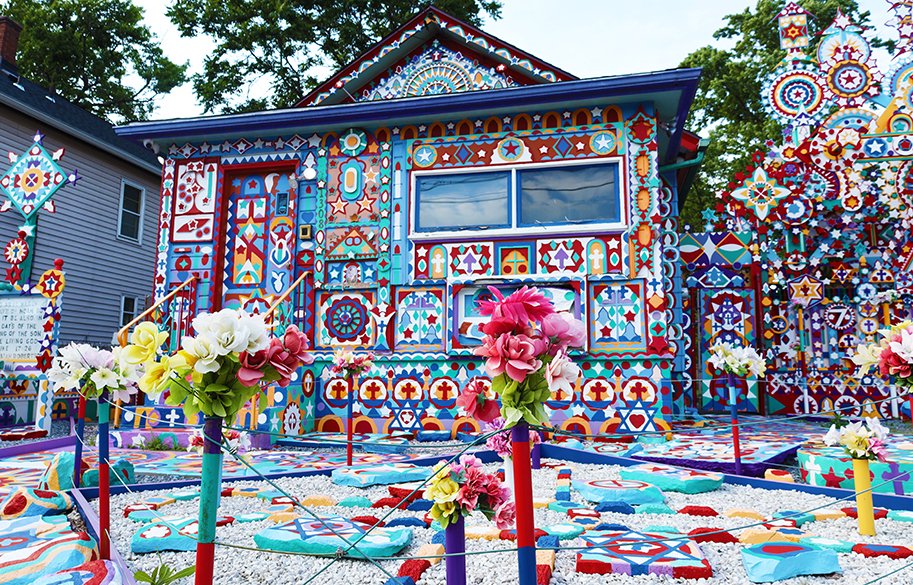
On Richmond Avenue in Buffalo, there’s a house that doesn’t look like any other house. It’s covered in symbols, writings, and imagery. It’s painted in distinctive colors. It’s visually striking and immediately distinctive. It’s the Second Coming House of Prophet Isaiah.
The house belongs to Prophet Isaiah Zonen, a religious visionary who has lived there for decades. The exterior is his canvas, filled with biblical prophecies, spiritual symbols, messages, and artwork covering the walls. It’s both a home and a statement, a lived prophecy made visible in paint and symbolism.
What it represents: The Second Coming House is an example of outsider art—art created by someone without formal training, motivated by internal vision rather than external approval. It’s also an example of how individuals can transform their immediate environment as an expression of spiritual belief.
Prophet Isaiah’s vision, that we’re living in the end times, that spiritual awakening is necessary, is expressed through the house itself. Every surface is intentional. Every symbol means something. It’s not random or chaotic; it’s organized around a coherent (if unconventional) worldview. The colors are bold. The symbolism is dense. It’s not “pretty” in a conventional sense, but it’s arresting. You can’t look at it without reacting to it. The house has been evolving for decades. New symbols appear. The colors shift and change. The external surface reflects the spiritual journey of the person living there.

Why Prophet Isaiah Created This:
Prophet Isaiah Zonen was born in Jamaica and migrated to the United States via Canada. While working as a contractor on Mt. Erie Baptist Church, he experienced something he interpreted as divine intervention. As he worked with his hands and tools, he began creating shapes and designs in the wood that he felt he couldn’t account for. He heard the voice of God and realized, he claims, that God was moving his hands and creating the designs through him.
After years of filling the church’s sanctuary walls with these divinely-guided creations, God called upon him to begin his second prophecy—this time at his own home on Ontario Avenue. Around 2007, Prophet Isaiah began building and designing what covers his house today, and he has continued working tirelessly ever since. He tells visitors that the cross at his home is the final cross—the one that all sentient beings will see as they make their last walk down Ontario Avenue, facing one final decision whether or not to follow and believe in Jesus Christ. According to his theology, after passing the cross on Judgment Day, everyone will proceed one by one to Goat’s Island where Jesus Christ will direct believers to everlasting salvation or to eternal damnation.
His house, then, is not decoration or art. It’s a spiritual artifact—a prophecy made visible, a message from God through his hands, a warning and invitation simultaneously covering the physical structure of his home.
There is still so much mystery surrounding this home BUT you can drive by and see it’s colorful splendor for yourself while driving through the area.
Why Buffalo’s Weirdness Matters
Buffalo isn’t weird because it’s trying to be. It’s weird because it’s authentic. These places, the flame that shouldn’t burn, the gimmicky historical pub, the visionary house, the supposed haunted museum, the commercialized natural wonder—they’re all expressions of Buffalo’s character. A city that’s been through economic collapse, that’s had to reinvent itself, that’s learned resilience and creativity out of necessity.
The weird places are where Buffalo’s soul shows itself. They’re where creativity, spirituality, stubbornness, and hope collide.
That’s why they’re worth visiting.
Want to dive deeper into Buffalo’s alternative side? Check out local bookstores, visit during art festivals (Buffalo has an active arts scene), and talk to locals about their favorite unusual places. Every Buffalonian has a weird spot they love.
Visiting Niagara region? Consider combining a Buffalo trip with time at Niagara Falls and across the border in Ontario to see how different communities have approached tourism and preservation. Enjoy the history. Embrace the personality. And stay weird!
Recent Podcast Episodes

Recent Adventures



Subscribe Today!
Subscribe
Your Ad Here!

Other Adventures You May Like

The Berners Street Hoax Buried One London Address in Unwanted Deliveries

Nils Olav, the Penguin the Norwegian Army Keeps Promoting
