
The 19th-Century Obsession with “Electricity Baths”
The Victorian era was a wild time to be alive, mostly because people finally figured out how to harness the fundamental forces of the universe. Immediately, they decided to use them for spa treatments. If you think our current obsession with LED face masks and vibrating lymphatic drainage tools is peak “tech-pseudo-science,” let me introduce you to the 19th-century Electricity Bath.
It was the original bio-hacking, just with a much higher risk of accidental cardiac arrest. So… let’s learn a little bit more about it.

The “Universal Fluid” Marketing Strategy
To understand the electricity bath, you have to understand the Victorian lifestyle: they were obsessed with “invigoration.” They believed the human body was essentially a battery that could run low on “nervous fluid.” If you were tired, depressed, or, God forbid, suffering from “hysteria,” it was simply because your internal voltage was dropping.
When Michael Faraday and his peers started making electricity a household word, the medical world saw the literal “spark of life.” Doctors began marketing electricity as a “universal stimulant.” It was the 19th-century version of an espresso shot. However, it was delivered via a copper wire and a tub of lukewarm water.
How to Literally “Shock” Your System
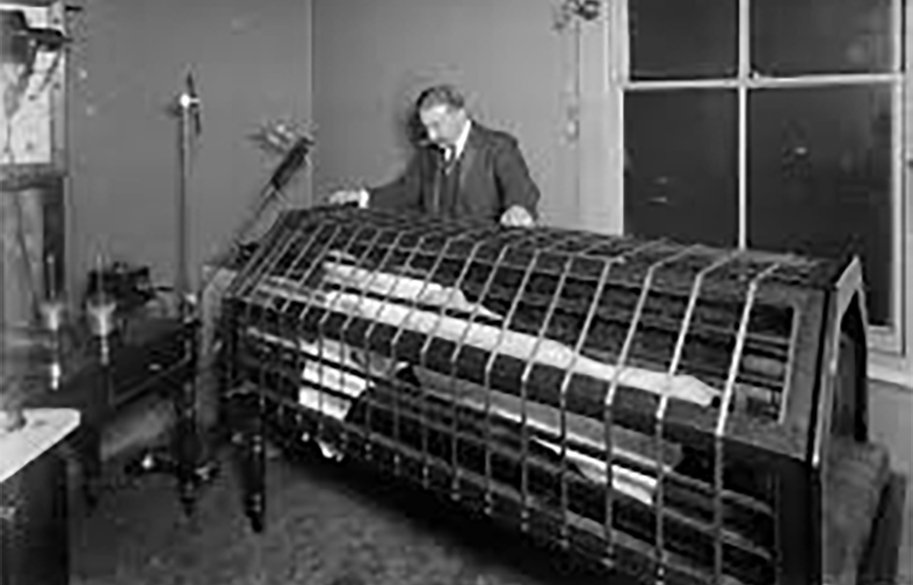
The setup for an electricity bath was exactly as terrifying as it sounds. You’d climb into a standard porcelain bathtub (or a wooden one if the doctor was fancy), and then the practitioner would dip two metal electrodes into the water. Sometimes they’d give you a metal rod to hold onto. This was just to make sure the current really “traveled” through your vital organs.
The sensation was described as a “gentle, prickling warmth” or “a lively agitation of the skin.” In reality, they were essentially giving themselves a very controlled, very expensive, and very damp low-voltage shock.
They had two main flavors of electricity back then:
- Galvanic: A steady, continuous stream of current meant to “soothe” deep-seated pain.
- Faradic: An interrupted, pulsing current that made your muscles twitch involuntarily—the 1880s version of a “EMS” (Electrical Muscle Stimulation) workout.
The “Electric Girl” and the High-Society Hype
This was a high-society status symbol. If you had “the vapors” or “neurasthenia” (which was basically the Victorian term for being burnt out by the crushing weight of social etiquette), your doctor would prescribe a six-week course of electric baths.
It became a full-blown subculture. There were “Electrical Dispensaries” popping up in London and New York that looked more like luxury lounges than clinics. People would sit in these tubs, chatting about the latest scandal. Meanwhile, a technician dialed up the voltage. It was the original “self-care” day, except instead of a face mask, you were literally humming with 20 volts of direct current.
Of course, because this was the 1800s and safety regulations were basically a suggestion, things got dark. For every “invigorating” bath that made a Duchess feel refreshed, there was a horror story.
There were reports of patients being severely burned because the doctor forgot to dilute the current, or worse, “hydro-electric” accidents where the insulation failed and the patient became part of the circuit. But the most insidious part was the psychological grip it had. Because people felt something (the twitching, the heat, the tingling), they assumed it was working. In effect, it was the ultimate placebo effect with a side of mild electrocution.
Recent Podcast Episodes

Recent Adventures



Subscribe Today!
Subscribe
Your Ad Here!

Other Adventures You May Like

The Berners Street Hoax Buried One London Address in Unwanted Deliveries

Nils Olav, the Penguin the Norwegian Army Keeps Promoting
