
The Coolest, Weirdest Things to Actually Go See in Portugal
Portugal has a reputation for being pleasant. Tiles, custard tarts, beaches, elderly men playing cards in the shade. All accurate, all lovely. It also has a chapel decorated with five thousand skeletons. And a village where the houses wear boulders as roofs. And a lake with a giant hole in the middle that looks like a portal to somewhere else. The pleasant version is real. It’s just not the whole inventory. Here’s the stuff worth rearranging a trip for.
The Chapel Made of People, Évora
Start with the big one. The Capela dos Ossos sits inside the Church of São Francisco in Évora. Human bones cover its walls and columns. Roughly 5,000 people are in there. Skulls stacked in rows. Femurs arranged in patterns along the arches. Somebody assembled all of it with genuine care.
The reason is refreshingly practical. By the sixteenth century, Évora had more than 40 religious cemeteries eating up land inside the city. Something had to give. Three Franciscan monks decided that rather than just relocating everyone, they’d put the bones to work as a sermon.
The inscription over the entrance handles the message: we bones that are here await yours. Cheerful stuff. The intent was gentler than it sounds. It reminded a very religious population that earthly life is a stopover. Four centuries have not softened the delivery. Near the altar there are also two mummified bodies, an adult and a child, found during the same exhumations. Nobody eases you into that.
The Upside-Down Tower, Sintra
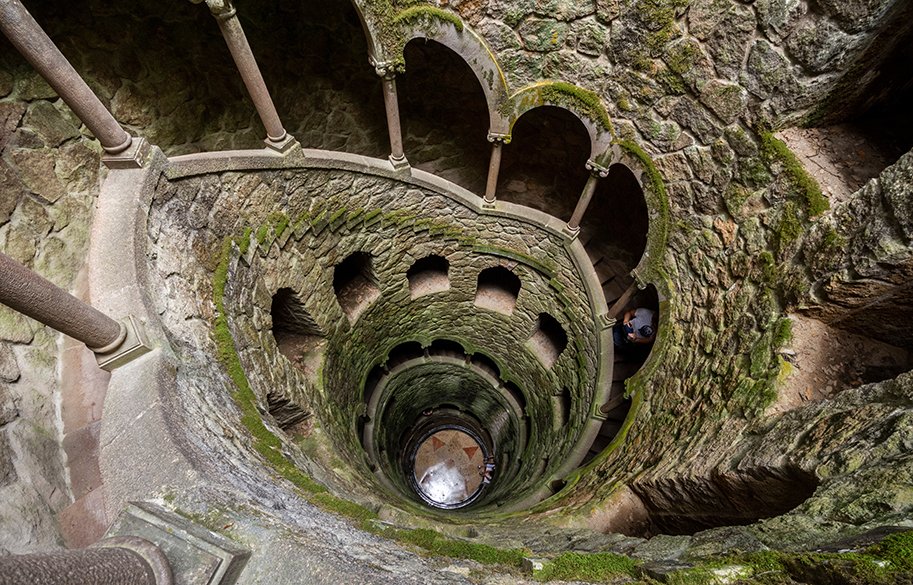
Quinta da Regaleira is a whole estate of strangeness, but the Initiation Well is the thing people travel for. Picture a spiral staircase sunk about 88 feet straight down into the ground. Stone-lined, mossy, lit only from the opening above. It looks like a tower that was built and then pushed into the earth. It never held water, and it was never meant to.
The design is loaded with symbolism, structured in nine platforms that many visitors connect to Dante’s circles. At the bottom, tunnels branch off and eventually spit you back out somewhere else in the gardens. It’s genuinely disorienting.
The man behind it was Carvalho Monteiro, a wealthy eccentric who bought the estate in 1892. He hired Italian architect Luigi Manini to build out his interests. Those interests reportedly included the Knights Templar, Freemasonry, alchemy, and assorted esoterica. He was also a serious entomologist with a 30,000-book library, because of course he was. Go early. The well is spectacular when it’s quiet. It’s considerably less mystical when you’re queuing behind a tour group.
The Hole in the Lake, Serra da Estrela
Covão dos Conchos is a lake high in the Serra da Estrela mountains. It appears to have a bottomless circular void in it, endlessly swallowing water. The internet has decided this is a portal. It’s not. It’s a bell-mouth spillway, finished in the 1950s. It channels water through a tunnel more than a kilometer long to feed a reservoir.
Knowing that does not make it less unsettling to look at. A perfectly circular waterfall in an otherwise ordinary alpine lake still reads as fundamentally wrong. Engineering explains it. Your instincts don’t accept the explanation. It’s a proper hike to reach, which keeps the crowds down.
The Village That Lives Under Boulders, Monsanto
Monsanto sits on a hillside in central Portugal, and the builders there made a decision most people wouldn’t. The slope is covered in enormous granite boulders, some the size of houses. Rather than clearing them, residents built around them, under them, and between them. Boulders form walls. Boulders form roofs. A single rock might cap an entire dwelling.
The effect is a village that looks partly geological. Streets narrow into gaps between stone. Doorways appear beneath overhangs. You keep recalibrating what counts as architecture versus what counts as landscape. It’s often called the most Portuguese village in Portugal, which came from a 1938 competition. That title undersells it. Very few places anywhere look like this.
Stones Older Than Stonehenge, Also Évora
A short drive from the bone chapel sits the Almendres Cromlech, and it does not get the attention it deserves. Nearly a hundred standing granite stones are arranged in ovals on a quiet hillside among cork oaks. The site dates back roughly 8,000 years, which makes it substantially older than Stonehenge and older than the Egyptian pyramids.
Some stones carry carved markings. The arrangement appears to align with solar events. So people tracked the sky here before writing existed anywhere on earth. And you can generally walk right up to them. No barriers, no crowds, no gift shop worth mentioning. On a weekday you might have the entire thing to yourself. That’s an absurd thing to say about a monument this old.
The Staircase That Makes You Work for It, Braga
Bom Jesus do Monte, just outside Braga in the north, is a sanctuary at the top of a hill. Getting up there is the point. A baroque stairway zigzags up the slope in a series of sharp switchbacks, flanked by fountains, statues, and chapels. Each landing represents a stage of a spiritual ascent, so the climb is meant to function as the pilgrimage itself rather than the annoying part before it.
There are 577 steps. Pilgrims have historically climbed some sections on their knees. If that sounds like too much, there’s an alternative that’s arguably stranger. A funicular has run up the hillside since 1882, and it’s powered entirely by water. Operators fill a tank on the upper car until it outweighs the lower one, gravity does the rest, and the whole thing has worked this way for over 140 years without an engine. It’s the oldest water-counterbalance funicular still operating anywhere in the world.
The Striped Houses, Costa Nova

Time for something cheerful after all the bones. Costa Nova, just outside Aveiro, is a beach town where the old fishermen’s houses are painted in bold vertical stripes. Red and white, blue and white, yellow and white, running down entire facades in a row. The stripes weren’t decorative originally. They helped fishermen pick out their own homes from the water in poor visibility. It’s a practical solution that happened to produce one of the most photogenic streets in the country. Nearby Aveiro leans into a canal-town identity, complete with colorfully painted moliceiro boats that once harvested seaweed. You can also tour the salt pans, which is a more interesting hour than it sounds.
The Cloud With a Rude Name, Sintra
One last thing, and it’s my favorite piece of local trivia in the country. A cloud frequently sits over the Pena Palace in Sintra. It hangs around the hilltop even on days when the rest of the sky is completely clear. It’s a real microclimate effect, driven by the hills catching moisture off the Atlantic. Locals call it the Queen’s Fart. That’s it. A fairytale palace in yellow and red, perched above the treeline. And the weather above it takes its name from royal flatulence. Portugal contains multitudes.
Recent Podcast Episodes

Recent Adventures



Subscribe Today!
Subscribe
Your Ad Here!

Other Adventures You May Like

Nils Olav, the Penguin the Norwegian Army Keeps Promoting

A Guide to Caravan Sales in NSW for First-Time Buyers
