
The Gordon Bennett Cup: The 1906 Balloon Race That Ended in International Chaos
On September 30, 1906, sixteen gas balloons lifted off from the Tuileries Gardens in Paris. Roughly 200,000 spectators watched them all launch at once. The goal sounded simple enough: fly as far as possible from the starting line and land safely. What actually happened involved a mid-race gamble across open water. It also involved one competitor’s balloon escaping without him, and an angry farmer filing a formal complaint. Not bad for the very first edition of an event that’s still running today.
A Newspaper Tycoon’s Idea of a Good Time
James Gordon Bennett Jr., the wealthy owner of the New York Herald, funded the race and gave it his name. He’d already sponsored plenty of eccentric sporting spectacles by then. But this one aimed squarely at the newest, riskiest frontier available: manned flight. Nobody had any real rulebook yet for how international ballooning was even supposed to work.
The format was straightforward on paper. Sixteen crews launched together, and whoever traveled the farthest distance in a straight line from Paris won. But nobody controlled the wind, and the wind that day had other plans.
Everyone Got Pushed Toward the Same Impossible Decision
A steady wind out of the southeast drove every single balloon toward the English Channel. That put every pilot in the exact same brutal spot at once. Land somewhere in France, or risk an open-water crossing in a wicker basket with zero rescue plan if things went wrong.
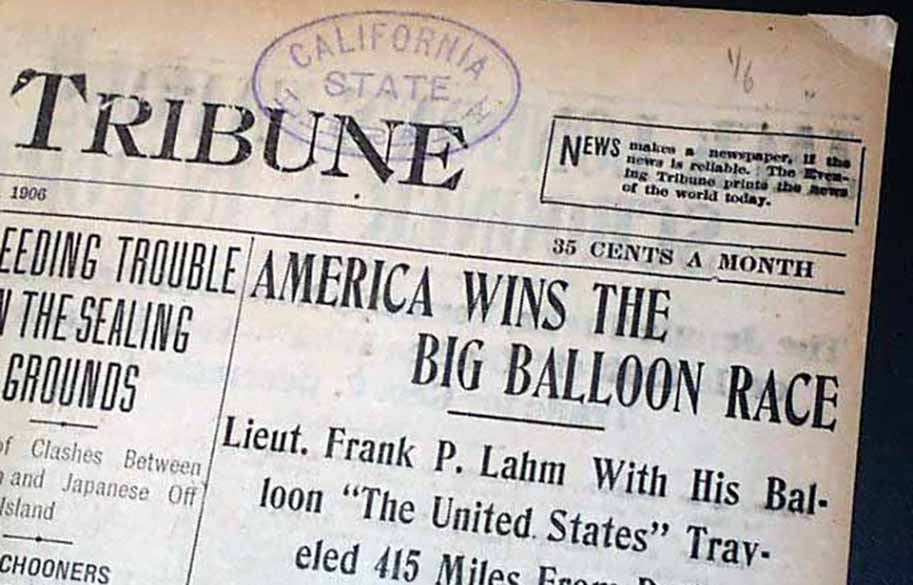
Seven crews made the jump anyway. Lieutenant Frank P. Lahm and his American co-pilot, Major Henry Hersey, cleared the Channel. They eventually came down in Yorkshire, England, after more than 22 hours in the air, roughly 400 miles from Paris. That distance won them the entire competition. The other nine balloons stayed over land, scattering across the French countryside with no coordination at all. Nothing like this had ever actually been attempted before.
One Pilot’s Balloon Left Without Him
Not every flight went smoothly. Alberto Santos-Dumont, already a genuine aviation celebrity by 1906, tried something nobody else even attempted. He flew a motorized balloon, adding a small engine to try to gain an edge. It went badly fast. His jacket caught in the propeller partway through the flight. That badly injured his arm and forced him down after only about 83 miles.
Then things got stranger. While Santos-Dumont went looking for a doctor, his balloon simply drifted off without him. It floated away completely unmanned, somewhere over the French countryside. Motorized balloons never competed in the race again after that.
A Farmer Filed an Actual Complaint
Even the aftermath had its own small chaos. An English farmer was furious that a trailing guide rope from an unidentified balloon had torn up his meadow. So he sent an angry telegram straight to the newly formed international aviation federation, demanding satisfaction. Not everyone shared his frustration, though. One local landowner, whose property the winning balloon happened to land on, felt differently. He reportedly said an earthquake couldn’t have drawn more attention than watching that balloon touch down.
Under the race’s own rules, the winning country automatically earned hosting rights for the following year. So the trophy, and the entire spectacle, packed up and moved to St. Louis in 1907, less than a year after chaos first broke out in a Parisian garden.
None of that turned out to be a deterrent. The Gordon Bennett Cup kept running for decades afterward, interrupted only by two world wars. It’s still held every year today, more than a century later. Lahm himself went on to help build the actual U.S. Air Force, putting his prize-winning flight to genuinely serious use. Not bad for a race that started with sixteen balloons, one dangerous gamble over open water, and a runaway aircraft.
Recent Podcast Episodes

Recent Adventures



Subscribe Today!
Subscribe
Your Ad Here!

Other Adventures You May Like

The Berners Street Hoax Buried One London Address in Unwanted Deliveries

Nils Olav, the Penguin the Norwegian Army Keeps Promoting
