
The Hand in the Desert: Chile’s Giant Sculpture Rising From the Atacama With No Town for Miles
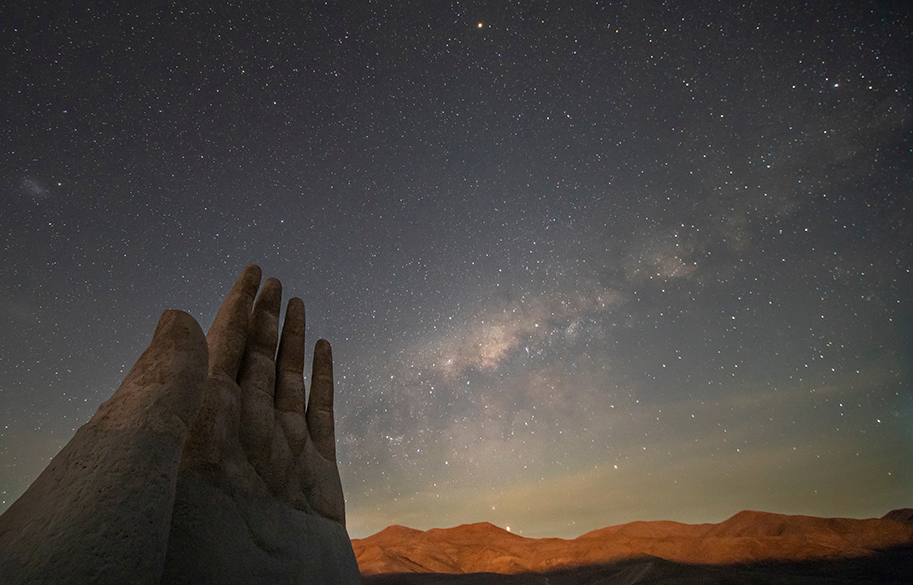
There is a 36-foot concrete hand rising out of the Atacama Desert in northern Chile. It sits beside the Pan-American Highway, about 46 miles south of the nearest city. The sculpture is surrounded by nothing in every direction except flat red sand. Just an enormous left hand reaching upward from the ground, alone, in the middle of one of the emptiest landscapes on the planet.
What It Is and Who Made It
The sculpture is called Mano del Desierto, which translates as Hand of the Desert. Chilean sculptor Mario Irarrázabal created it in 1992. A local booster organization from Antofagasta called Corporación Pro Antofagasta commissioned and funded it. They asked Irarrázabal to create something that would break the visual monotony of the desert and give the region a landmark. As a result, what they got was a 36-foot concrete hand on an iron frame. It was inaugurated on March 28, 1992, at an elevation of about 3,600 feet above sea level.
Irarrázabal was born in Santiago in 1940 and studied sculpture in Indiana, Rome, and Germany. He is known for making expressive figurative sculpture that deals with heavy themes. For instance, these themes are loneliness, vulnerability, injustice, and torment. He describes the Mano del Desierto as representing human weakness and fragility in the face of suffering, and as a tribute to victims of injustice and torture. Chile had recently emerged from the Pinochet dictatorship when the sculpture was built. In this context, reading the hand as a single arm reaching upward from underground as if trying to escape changes the experience of it significantly.
Irarrázabal has built similar giant emerging hands in other locations. An earlier version, the Monument to the Drowned, sits on a beach in Punta del Este, Uruguay. There, five fingers emerge from the sand as if someone is drowning beneath it. He made another for Madrid in 1987 and one for Venice in 1995. The desert version is the most famous of them. This is partly because the Atacama setting strips away every competing visual and leaves the hand alone with an enormous sky.
The Desert It Lives In
The Atacama is frequently described as the driest non-polar desert on Earth. Some weather stations there have never recorded rainfall. NASA has used the Atacama to test Mars rover technology because the conditions are close enough to Mars to be useful. The soil is so devoid of organic material that astrobiologists have studied it to understand what the limits of life look like. In summary, it is, by most measures, one of the least hospitable landscapes on the surface of the planet.
Driving south from Antofagasta on Route 5, the Pan-American Highway, the landscape is red and brown and flat in every direction for as far as you can see. At kilometer marker 1309, roughly 200 meters off the main road down an unpaved track, the hand appears. Furthermore, there is no gradual approach. It simply comes into view and then you are standing next to it.
No facilities exist on site. There is no parking structure, no bathroom, no water. Visitors bring everything they need. The sculpture itself has no barriers, so people can walk up to it and touch it. This has also led to ongoing problems with graffiti and vandalism. Irarrázabal has had to restore it multiple times over the years.
Recent Podcast Episodes

Recent Adventures



Subscribe Today!
Subscribe
Your Ad Here!

Other Adventures You May Like

Nils Olav, the Penguin the Norwegian Army Keeps Promoting

A Guide to Caravan Sales in NSW for First-Time Buyers
