
The Hieronymus Bosch Boat Tour: Sailing Through Hell Under a Medieval Dutch City
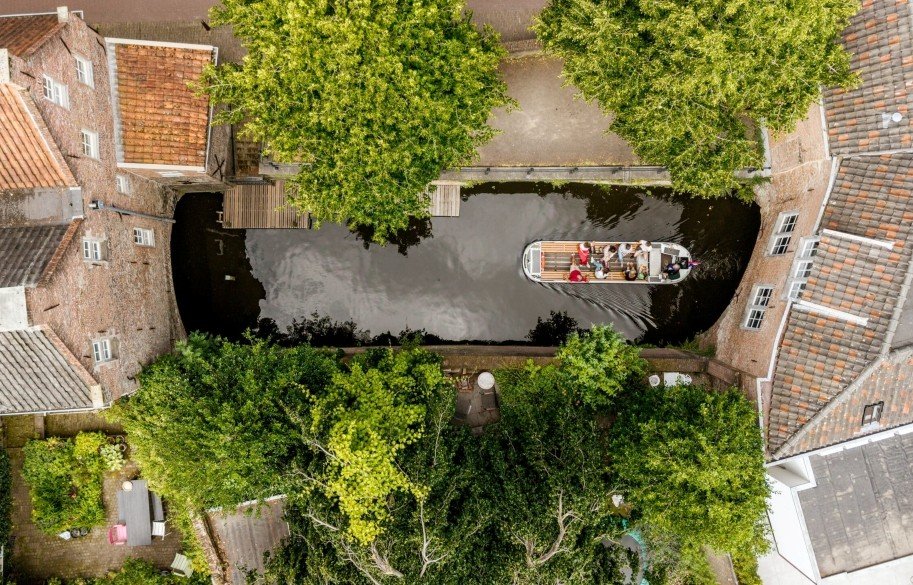
In the Dutch city of ‘s-Hertogenbosch, known as Den Bosch, you can get into a small boat and sail underneath the city through a network of medieval canals called the Binnendieze. The tunnels are narrow, the water is dark, and at a certain point you arrive at a section called the Hellegat. This translates, directly, as Hell Hole. As you arrive, a light show activates on the vaulted stone ceiling and walls. It projects the demons, monsters, and tortured souls from the paintings of Hieronymus Bosch onto the medieval stone around you.
Bosch was born in this city in 1450. He lived here his entire life. He painted the most vividly disturbing visions of Hell and human depravity that European art had seen up to that point. Furthermore, the people who run the boat tours believe that this particular tunnel, this specific dark hole under their city, is one of the things he was thinking about when he painted those visions. That might be apocryphal. The tour is extraordinary regardless.

What the Binnendieze Actually Is
The Binnendieze is a network of waterways, partly underground, that runs through and beneath the medieval city center of Den Bosch. Three rivers converged here in the Middle Ages: the Aa, the Dommel, and the Dieze. Medieval builders constructed the city partly over these waterways. This meant that eventually a significant portion of the canal system ran under houses, churches, and the old city hall rather than through open streets.
In the Middle Ages, these canals served as the city’s main transport system and also, less glamorously, as its sewer. Goods arrived by water and waste departed by water through the same channels. Only about 30 percent of the original canal network survives today, but what remains is now protected as a historical monument. Moreover, the restoration work that made the boat tours possible began in the 1970s, when the canals had largely fallen into disrepair and partial dereliction.
The tours depart from Voldersgat in the city center and run roughly 90 minutes. Local volunteers from an organization called Kring Vrienden van ‘s-Hertogenbosch run them, which gives the experience a genuinely enthusiastic quality. These are people who find their city’s underground waterways interesting enough to spend their weekends guiding strangers through them. This turns out to be contagious.
The Bosch Connection
Hieronymus Bosch spent his life in Den Bosch at a time when the city was one of the four major cities of the Duchy of Brabant, alongside Leuven, Brussels, and Antwerp. It was a significant place, commercially wealthy, with a substantial religious culture and a Gothic cathedral. The Sint-Jan took over 300 years to build.
Bosch was a member of the Brotherhood of Our Illustrious Lady, a religious confraternity based at the Sint-Jan. He made church decorations and altarpieces. He was, in the context of his own city, a respectable craftsman with conventional religious affiliations. His paintings, however, are anything but conventional. The Garden of Earthly Delights, currently in the Prado in Madrid, depicts paradise, human depravity, and Hell in hallucinatory detail across three panels. In addition, the hell panel shows Den Bosch burning in the background, recognizable to anyone who knew the city’s skyline.
The Hellegat tunnel would have been a familiar piece of the city’s infrastructure to Bosch. The tunnel is said to have inspired Hieronymus Bosch. However, how much this claim is based on documented evidence versus local legend is difficult to establish. What is easier to establish is that the dark, vaulted, dripping tunnels of the Binnendieze look exactly like the kind of environment that produced someone who painted what Bosch painted, regardless of the specific biographical connection.
Since 2016, when the city marked the 500th anniversary of Bosch’s death, Den Bosch has placed 24 life-size sculptures of his creatures along the canal routes. You sail past them in the water and spot them in unexpected places along the banks. For example, a fish walking on human legs. Also, a giant pair of ears. Finally, a creature that does not have a clean description available in modern language.
What Else to Do There
Den Bosch is an hour by train from Amsterdam and genuinely worth a full day rather than just the boat tour. St. John’s Cathedral is one of the most impressive Gothic churches in the Netherlands. The Jheronimus Bosch Art Center, housed in a former cathedral, has no original paintings since all the originals are in major museums worldwide. However, it has excellent full-scale reproductions and the best available account of Bosch’s life and context. You can climb to a viewing platform 130 feet up for views over the city.
The Bossche Bol is the city’s other major cultural contribution: a tennis-ball-sized choux pastry filled with whipped cream and coated entirely in dark chocolate. It is not subtle. It is very good. You can buy Bossche Bol earrings in the tourist shops, which gives you some sense of how seriously the city takes its pastry.
Book the boat tour in advance. It sells out on weekends, and there are a limited number of boats. The Jheronimus Bosch themed tour, the Heaven and Hell route, is the one to book if you want the Hellegat light show. The historic route gives you more of the canal history and less of the monster projections. Therefore, which is a legitimate choice depending on what you are after.
Recent Podcast Episodes

Recent Adventures



Subscribe Today!
Subscribe
Your Ad Here!

Other Adventures You May Like

Nils Olav, the Penguin the Norwegian Army Keeps Promoting

A Guide to Caravan Sales in NSW for First-Time Buyers
