
The History of the Orgasmatron: Wilhelm Reich and the Orgone Box
Somewhere between science, obsession, and outright controversy sits one of the strangest ideas to come out of the 20th century: a box that could supposedly collect life energy and, depending on who you asked, improve your health, your mood, and even your sex life.
It was called the “orgone accumulator,” though it later picked up a much more dramatic nickname: the orgasmatron. And it all traces back to one man: Wilhelm Reich.
From Freud to… Something Else Entirely
Reich didn’t start out on the fringes. He was actually a student of Sigmund Freud and was, for a time, a respected figure in early psychoanalytic circles.
His work focused heavily on the connection between psychological health and sexual repression. Reich believed that emotional issues weren’t just “in the mind”—they were stored in the body, creating what he called “character armor,” a kind of physical tension that blocked natural emotional and biological processes.
So far, not entirely outlandish. Even today, the idea that stress and emotion can manifest physically isn’t controversial. But Reich kept going.
The Discovery of “Orgone Energy”
At some point, Reich became convinced that there was a universal life force present in all living things. He called it “orgone energy.” According to him, this energy was everywhere, in the air, in the body, in nature—and it was directly tied to health, vitality, and sexual well-being. If your orgone energy was flowing freely, you were healthy. If it was blocked or depleted, problems started to appear.
This is where things started drifting away from mainstream science. Reich didn’t just theorize about orgone. He claimed he could measure it, observe it, and most importantly, collect it.
The Box
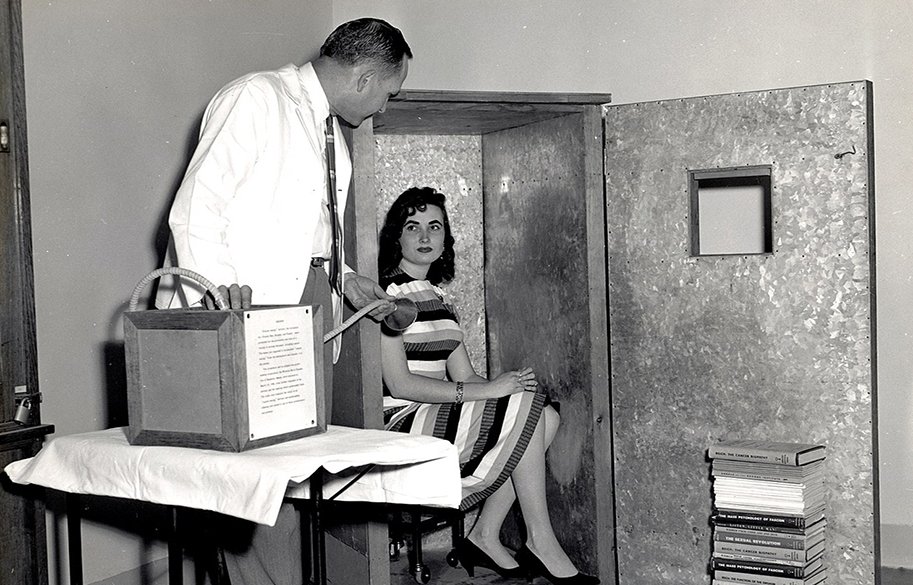
To capture this energy, Reich designed the orgone accumulator. It was essentially a box large enough for a person to sit inside, built from alternating layers of organic and metallic materials. The idea was that these layers would draw in orgone energy from the surrounding environment and concentrate it inside the box.
Patients would sit in it for sessions, sometimes daily, with the goal of “recharging” their energy levels. From the outside, it looked… simple. A wooden box. No wires, no obvious machinery. Which is part of why it attracted both curiosity and skepticism.
Reich claimed the box could help with everything from fatigue to more serious illnesses. He also linked it to improved emotional release and sexual health, which is how the more sensational nickname started to stick later on.
Public Fascination and Growing Skepticism
For a while, Reich’s ideas gained attention, especially in the U.S., where he had moved after leaving Europe. But the scientific community, for the most part, rejected his claims. There was no reliable evidence that orgone energy existed, let alone that it could be collected or used therapeutically. Still, Reich continued his work, publishing books, building devices, and promoting his theories.
In the 1950s, the FDA investigated Reich and concluded that the orgone accumulator was being marketed as a medical device without scientific backing. A court order was issued banning the distribution of the boxes and related materials.
What followed was one of the more unusual chapters in scientific history: authorities seized and destroyed orgone accumulators, and even burned some of Reich’s publications. Reich himself was eventually imprisoned for violating the court order, and he died in custody in 1957.
Recent Podcast Episodes

Recent Adventures



Subscribe Today!
Subscribe
Your Ad Here!

Other Adventures You May Like

The Berners Street Hoax Buried One London Address in Unwanted Deliveries

Nils Olav, the Penguin the Norwegian Army Keeps Promoting
