
The Imperial Regalia of Japan: The Three Sacred Treasures No Emperor Has Ever Actually Seen
On May 1, 2019, Emperor Naruhito ascended the Chrysanthemum Throne. Court chamberlains carried two black lacquered boxes into the Pine Room and set them on tables beside him. He took possession of them. Nobody opened them. That’s it. That’s the ceremony. The most important objects in Japanese imperial tradition changed hands. Not one person in the room saw what was inside, including the new emperor. Then everyone went home.
Three Objects, Two of Which Showed Up
The Sanshu no Jingi, or Three Sacred Treasures, are a sword, a mirror, and a jewel. The sword is Kusanagi no Tsurugi, and it stands for valor. The mirror is Yata no Kagami, for wisdom. The jewel is Yasakani no Magatama, for benevolence. Together they’re the proof that an emperor is legitimately an emperor. So they’re roughly the Japanese equivalent of a crown, except nobody wears them and nobody looks at them. The mirror didn’t even attend the 2019 ceremony. It stayed at Ise Grand Shrine, about 200 miles away, and sent its regards.
The Origin Story Involves a Cave and a Very Large Snake
The mythology here is genuinely great, so it’s worth the detour. Amaterasu, the sun goddess, got into a fight with her brother Susanoo. So she shut herself inside a cave, which plunged the world into darkness. The other gods needed her out. So they hung a mirror and some curved jewels outside the cave and threw a loud party.
Amaterasu, curious about the noise, peeked out. She caught sight of her own reflection, didn’t immediately recognize it, and came closer for a better look. The gods grabbed her. Light returned to the world. Her own reflection, in other words, lured the sun goddess out of hiding. There’s a whole essay in that.
The sword arrives separately. Susanoo, apparently working off some guilt, went and killed an eight-headed serpent called Yamata no Orochi. While carving up the body, he found a sword inside its tail. He handed it to Amaterasu as a peace offering. Amaterasu later gave all three objects to her grandson Ninigi when she sent him down to rule the islands. Ninigi passed them to Emperor Jimmu, traditionally in 660 BCE, and from Jimmu they descended through every emperor since.
Nobody Is Allowed to Look
Here’s the part that trips people up. The secrecy isn’t a security policy. It’s the whole point. Only a tiny number of senior Shinto priests and imperial household officials go anywhere near these objects. Even then, the items generally stay in their boxes. By tradition, the emperor himself doesn’t view the mirror or the jewel.
So no photographs exist. No detailed descriptions exist. No independent verification of any kind exists. Everything anyone says about what these objects look like is either tradition or guesswork. Which raises the obvious question that nobody in Japan is especially eager to answer.
Are They Even Still There?
Probably not the originals, is the honest answer. Start with the sword. Accounts hold that it went down at sea in 1185, during the naval battle of Dan-no-ura. The losing side drowned rather than surrender, and took the child emperor Antoku with them. The sword reportedly went into the water and was never recovered. A replacement got made.
The sword used in modern ceremonies is openly a replica anyway. Tradition places the original at Atsuta Shrine in Nagoya. Whether that’s the same object Susanoo pulled out of a snake is not a question the shrine invites. The mirror may have had it worse. Some historians think an eleventh-century fire damaged or destroyed it, leaving only fragments at Ise. The secrecy cuts both ways here. Nobody can say how many times these items have quietly changed across two thousand years of history.
There’s a genuinely striking moment in 1945 that shows how seriously this is taken. In late July of that year, Japan faced invasion and the war was clearly lost. Emperor Hirohito spoke with Kōichi Kido, the Lord Keeper of the Privy Seal. Among the things weighing on him was the fate of the regalia. He expressed real resolve about protecting them from Allied forces. Their survival, in his mind, was bound up with the survival of the imperial line itself. The objects came through the war untouched. Ise and Atsuta were never bombed.
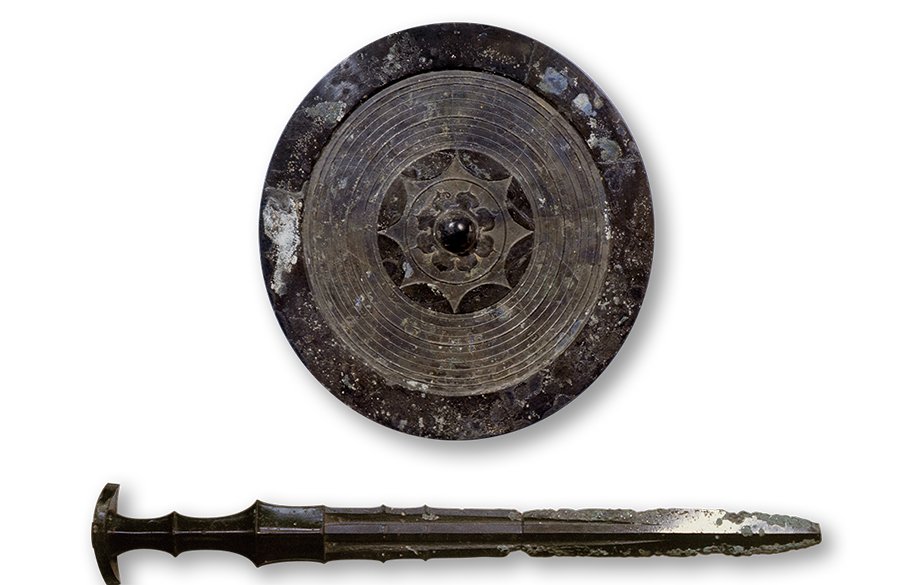
The Problem the Boxes Can’t Solve
There’s an awkward wrinkle sitting underneath all this ceremony, and it has nothing to do with whether the objects are real. Japanese law currently bars women from the throne. Naruhito has one child, a daughter, Princess Aiko. So the treasures that have supposedly passed down an unbroken male line for more than two millennia are facing a succession problem that no amount of ritual can fix.
The regalia can’t help here. That’s the flip side of their design. Because their authority comes from the ritual rather than the objects, they only work as long as there’s someone the rules permit to receive them. Hand them to the wrong person and they’re just boxes again. Japan has debated changing the succession law for years without resolving it. Meanwhile the sword, the jewel, and the mirror sit exactly where they’ve sat, waiting to find out what happens next.
The Power Is in Not Looking
Because the regalia are never seen, they cannot really be stolen in any meaningful way. As one historian told reporters in 2019, the treasures cannot support a usurper’s claim to the throne. Steal them and you have some boxes. Their authority doesn’t live in the objects. It lives in the ritual, in the continuity, in the fact that everyone agrees the transfer happened.
Compare that to European crown jewels. Those sit in display cases, get photographed constantly, and occasionally get stolen in genuinely embarrassing fashion. Japan solved that problem by declining to show anyone the merchandise. It’s a system where the mystery does the work. And it has run for centuries without anybody breaking the seal out of curiosity.
Recent Podcast Episodes

Recent Adventures



Subscribe Today!
Subscribe
Your Ad Here!

Other Adventures You May Like

The Berners Street Hoax Buried One London Address in Unwanted Deliveries

Nils Olav, the Penguin the Norwegian Army Keeps Promoting
