The New Deep-Sea Coral Species Scientists Named After Chewbacca
In 2006, a remotely operated vehicle was creeping along the seafloor off the northern coast of Molokai, Hawaii. It was about two-thirds of a mile down. Something strange came into view on an unnamed underwater mountain. Long, shaggy, upright branches, covered in what looked almost like fur. The researchers watching the footage knew exactly what it reminded them of. They just weren’t ready to name it yet.
A Photo That Sat on an Office Door for Nearly Twenty Years
Les Watling, a biologist at the University of Hawaii at Manoa, was part of the team that first spotted the coral back in 2006. He described the moment simply: seeing it for the first time was unforgettable. Its long, flexible branches and overall shape immediately reminded him of Chewbacca, the furry Wookiee from Star Wars.
He printed a photo of it and stuck it on his office door at Edmondson Hall, on the University of Hawaii campus. Then, oddly enough, nothing happened for a long time. Watling was busy identifying other deep-sea corals. This one, striking as it was, sat unpublished for years, just a picture on a door in a university building, waiting for someone to finally connect it to something.
The Same Creature, Found Again a Decade Later
In 2016, an entirely different expedition explored a seamount near the Mariana Trench, the deepest known point in the entire Pacific Ocean. Their robotic camera spotted what looked like the same unusual coral. Nobody connected the two sightings right away. Years later, Watling sat down to review new research submitted by colleagues in China. Only then did he realize he was looking at the exact same species he’d photographed off Molokai a full decade earlier.
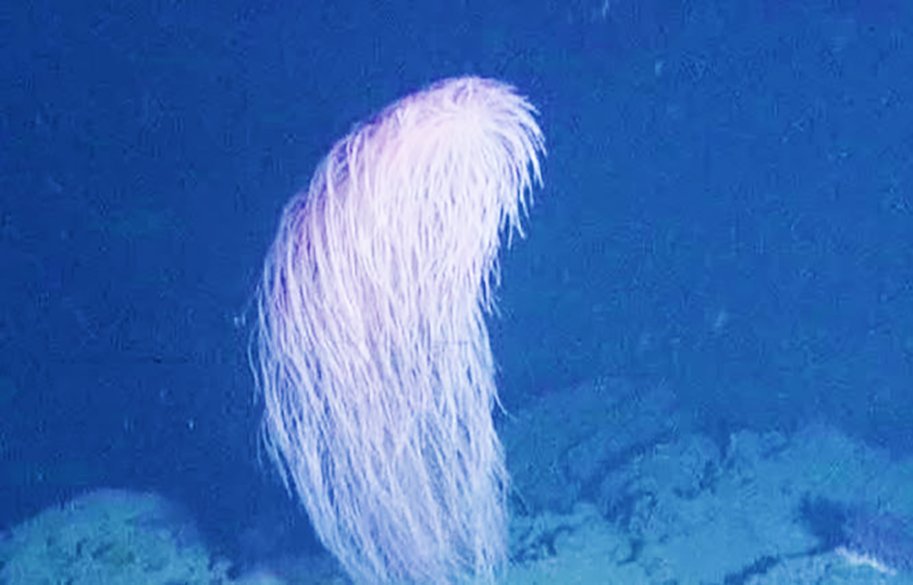
That connection finally turned into a real scientific description. The formal study, co-authored by Watling and Chinese researchers Yu Xu, Sifeng Zhan, and Kuidong Xu, appeared in the journal Zootaxa in 2025. The species got an official name: Iridogorgia chewbacca.
What Makes a Coral Look Like a Wookiee
The coral belongs to a genus called Iridogorgia, a group of deep-sea corals known for long, spiraling branch structures. Like any coral, it’s not actually one single organism. It’s a colony, thousands of tiny individual polyps working together to build one larger shape. The Molokai specimen stood about four feet tall. The Mariana Trench specimen measured closer to 20 inches. Individual branches on both can stretch up to 15 inches long, flexible and shiny, with a texture researchers kept describing as hairy. One writer covering the discovery called it downright cryptid-like, which, once you’ve seen the photos, feels about right.
Despite how large and dramatic it looks, Iridogorgia chewbacca tends to live completely alone, scattered here and there across deep, rocky seafloor. One tall, shaggy, solitary figure standing on the ocean floor in near-total darkness. It’s honestly a pretty fitting way for a coral named after Chewbacca to spend its life.
The same study that formally named this species also described a second new coral, Iridogorgia curva, and documented the broader diversity of the genus across the region. Researchers found that the tropical western Pacific holds a surprising amount of Iridogorgia diversity, with ten distinct species now recorded there.
Recent Podcast Episodes

Recent Adventures


Subscribe Today!
Subscribe
Your Ad Here!

Other Adventures You May Like

The Berners Street Hoax Buried One London Address in Unwanted Deliveries
Nils Olav, the Penguin the Norwegian Army Keeps Promoting