
The Rohonc Codex: The Other Undeciphered Manuscript Nobody Can Crack
Everyone knows the Voynich Manuscript by now. It’s the internet’s favorite unsolved mystery book, all those strange botanical drawings and looping, alien handwriting nobody’s ever cracked. But Hungary has its own version sitting quietly in an academy library. Honestly, it might be the weirder puzzle of the two. It’s called the Rohonc Codex. After nearly two hundred years, people still can’t agree on whether it’s a genuine lost language or an elaborate 19th-century prank.
Nobody Actually Knows Where This Thing Came From
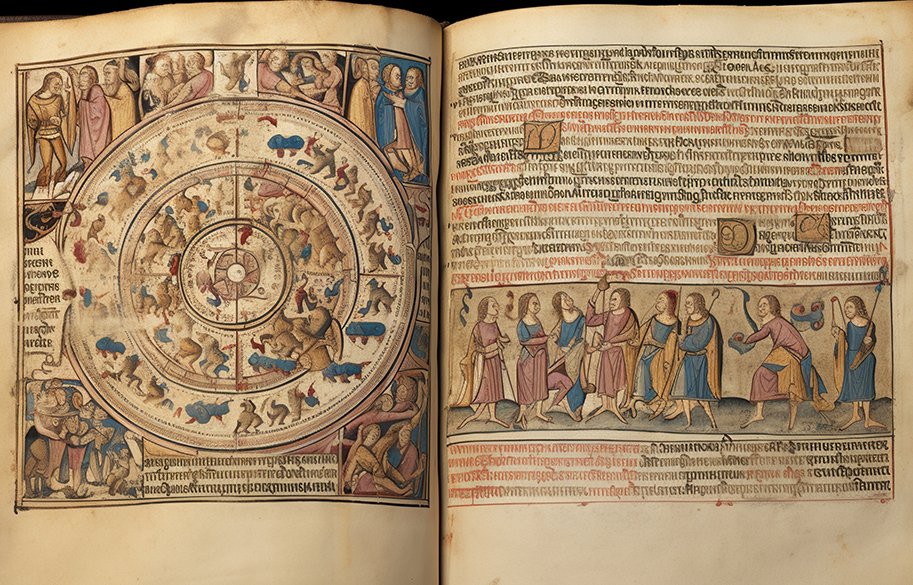
In 1838, a Hungarian count named Gusztáv Batthyány donated his entire personal library to the Hungarian Academy of Sciences. Buried inside it was a small, dense manuscript, just 12 by 10 centimeters, packed with 448 pages of tight, unreadable script. Nobody knew where he’d gotten it. Nobody still does.
The book uses somewhere between 150 and 200 distinct symbols, arranged in 9 to 14 rows per page. Scholars can’t even agree on which direction it’s meant to be read. About 90 crude little illustrations run through it too, mixing Christian imagery with battle scenes. There’s even what looks like a crescent moon in a few places. That’s the kind of detail that makes you wonder if whoever wrote this was borrowing from more than one religious tradition at once.
The Obvious Answer Turned Out to Be Complicated
For a long time, the simplest explanation seemed to be fraud. In 1866, a historian named Károly Szabó pinned the whole thing on Sámuel Literáti Nemes. Nemes was a well-known 19th-century forger who’d already fooled plenty of respected scholars with fake historical relics. Nemes wasn’t some random con man, either. He co-founded Hungary’s National Széchényi Library. A forger with actual institutional credibility is exactly the kind of detail that makes a hoax theory feel plausible.
Except the case against him doesn’t actually hold up that well. Researcher Benedek Láng has pointed out that the codex never shows up in any of Nemes’s own surviving papers, unlike his other known fakes. It doesn’t match his usual style, either, since his real forgeries were all built to look convincingly Old Hungarian. This one just doesn’t read that way. And here’s the detail that really complicates things. The paper itself has been dated to 16th-century Italy, a strange choice of material for a man supposedly faking a document two centuries later.
The Numbers Started Looking Too Real to Be Fake
Modern analysis added another wrinkle. Run the text through computational tools, and it follows Zipf’s Law. That’s a statistical pattern found in basically every real human language, describing how often certain words repeat relative to others. Forgers tend to produce something close to random noise when they’re inventing a fake script. Genuine languages don’t look random at all. The Rohonc Codex, statistically speaking, looks a lot more like the second thing.
Earlier generations of scholars had already tried and failed to crack it the obvious way. They hunted for matches against known alphabets in 1840, 1884, and 1890. None of it worked, because they kept assuming the symbols represented a brand-new language entirely.
Then Someone Tried a Completely Different Approach
In 2018, two Hungarian researchers, Gábor Tokai and Levente Zoltán Király, flipped the whole problem around. Instead of hunting for a new alphabet, they treated the Rohonc Codex as a cipher hiding something familiar underneath. It was likely Hungarian itself, they argued, just written out in an unusual syllabic system rather than a totally invented tongue. That single shift in approach has done more for this mystery than a century and a half of failed attempts before it.
Full translation still isn’t finished. But for the first time, it genuinely looks possible. That puts the Rohonc Codex in a strange, hopeful position most unsolved manuscripts never reach. Somewhere in a Budapest archive, someone might genuinely be a few years away from finally reading a book that’s kept an entire country guessing since before photography existed. The Voynich Manuscript gets all the attention. This one might actually get solved first.
Recent Podcast Episodes

Recent Adventures



Subscribe Today!
Subscribe
Your Ad Here!

Other Adventures You May Like

The Berners Street Hoax Buried One London Address in Unwanted Deliveries

Nils Olav, the Penguin the Norwegian Army Keeps Promoting
