
The Sailing Stones of Death Valley: The Rocks That Move Across the Desert Floor With No One Pushing Them
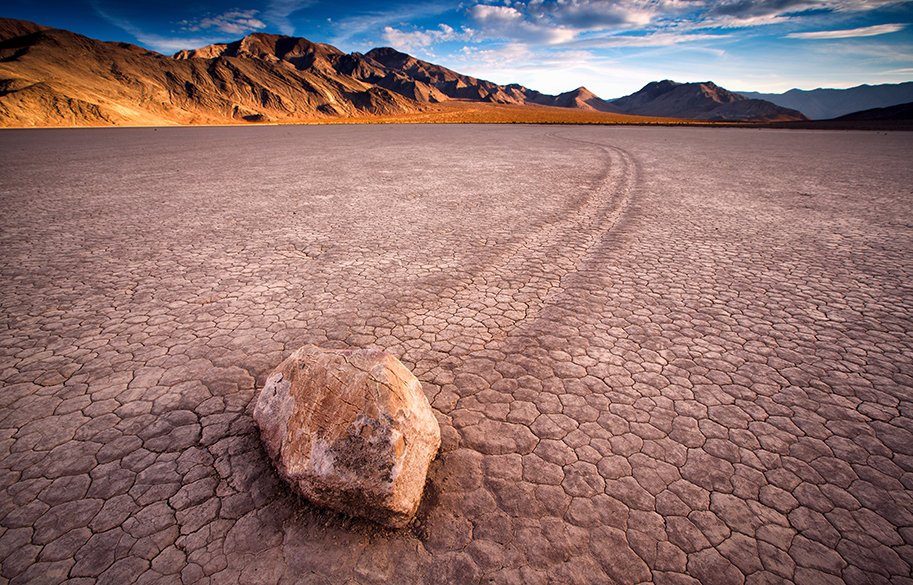
Rocks sit scattered across a dry lakebed in Death Valley. Behind each one trails a long, carved track in the mud, sometimes stretching hundreds of yards. The rocks clearly moved. Nobody has ever actually seen one do it. This is Racetrack Playa. For most of the 20th century, its wandering stones stood as one of the genuine unsolved mysteries in American geology.
A Lakebed Full of Rocks That Shouldn’t Move
Racetrack Playa is a flat, dry lakebed in Death Valley National Park, roughly three miles long and two miles wide. It formed about 10,000 years ago, when an ancient lake evaporated and left behind a vast stretch of hardened mud. Hundreds of rocks now sit scattered across its surface. Some weigh only a few ounces. Others weigh up to 700 pounds. They tumbled down from the surrounding mountains over centuries of ordinary erosion.
Each rock drags a track behind it, sometimes running perfectly straight, sometimes curving unpredictably. Researchers had studied these tracks since the early 1900s. Nobody could explain them. Theories ranged from strong desert winds to Earth’s magnetic field to slippery mats of algae. Some people, only half joking, blamed aliens.
Two Cousins and a Very Lucky Winter
The real answer came from an unlikely research team. Paleobiologist Richard Norris teamed up with his cousin Jim Norris, an engineer, and planetary scientist Ralph Lorenz. Starting in 2011, they installed a high-resolution weather station on the playa. They also fitted 15 rocks with motion-activated GPS trackers. They expected to wait five or ten years before catching any actual movement.
They got lucky almost immediately. In December 2013, the team arrived to find Racetrack Playa covered in a shallow pond of water, only about three inches deep. Shortly after, the rocks started moving. Over the following two and a half months, the researchers documented five separate movement events. Some involved hundreds of rocks sliding at once.
What Actually Moves Them
The mechanism turned out to require an oddly specific combination of conditions, all lining up at the same time. First, rain or snowmelt has to fill the playa with water. That water needs to be deep enough to freeze into a thin sheet overnight, but shallow enough to leave the rocks still exposed near the surface. On cold nights, the water freezes into a delicate layer of ice. Some call it windowpane ice, because of how thin and glassy it looks.
When morning sun warms the playa, the ice sheet begins to break apart into large floating panels. Light wind then pushes those floating panels across the standing water. As the panels drift, they shove against the exposed rocks, effectively bulldozing them across the soft, saturated mud underneath.
The whole process happens astonishingly slowly. Rocks creep along at roughly six to sixteen feet a minute, barely faster than a very slow walk. Rocks with rough, uneven bottoms leave straight, scratched tracks. Rocks with smoother bottoms tend to wander, curving unpredictably as they slide. Any individual stone typically only moves once every two or three years. The tracks it leaves behind usually fade within three or four years after that.
Recent Podcast Episodes

Recent Adventures



Subscribe Today!
Subscribe
Your Ad Here!

Other Adventures You May Like

The Berners Street Hoax Buried One London Address in Unwanted Deliveries

Nils Olav, the Penguin the Norwegian Army Keeps Promoting
