
The Sedlec Ossuary: The Czech Chapel Decorated With 40,000 Human Bones
A chandelier hangs from the ceiling of a small chapel outside Prague. Builders shaped it to contain at least one example of every bone in the human body. Nearby, a family coat of arms stretches across a wall, rendered entirely in bleached bone. Garlands of skulls drape along the vaulted ceiling. Four massive bell-shaped mounds of bones rise in the corners of the room.
This is the Sedlec Ossuary, and somewhere between 40,000 and 70,000 people make up the material it’s built from.

A Handful of Holy Dirt Started All of This
The story begins in 1278. King Otakar II of Bohemia sent Henry, the abbot of the Cistercian monastery at Sedlec, on a diplomatic mission to the Holy Land. Before leaving Jerusalem, Henry gathered a handful of earth from Golgotha, the site where Christians believe Jesus was crucified. He scattered it over the monastery’s cemetery back home.
That single gesture transformed an ordinary cemetery into one of the most desirable burial sites in Central Europe. Word spread that the ground itself was now holy. Wealthy families across Bohemia and beyond began requesting burial at Sedlec specifically. The cemetery expanded dramatically to accommodate them, long before anyone had a plan for what to do when it inevitably ran out of room.
Then Death Arrived at a Scale Nobody Had Planned For
Room ran out fast. A famine struck Kutná Hora in 1318, killing as many as 20,000 people in the region. Plague swept through decades later, adding tens of thousands more. The Hussite Wars in the early 15th century piled on further casualties on top of that. By then, the small monastery cemetery, already swollen with pilgrims hoping for a holy resting place, had to somehow absorb the dead of a genuine regional catastrophe.
Sometime after 1400, an abbot had the Church of All Saints built directly on the cemetery grounds. Beneath it sat a chapel meant specifically to hold bones that workers had to exhume to make room for new burials. Around 1511, a half-blind Cistercian monk took on the job of gathering and stacking the displaced skeletons into that chapel. Nobody recorded his name. He simply began organizing what would eventually become one of Europe’s strangest architectural projects, one bone at a time.
A Noble Family Hired a Woodcarver, and Everything Changed
For centuries the bones sat in the chapel in enormous, largely unstructured piles. That changed in the 1870s. The Schwarzenberg family, who had taken over patronage of the church, hired a local woodcarver named František Rint to bring some order to the space.
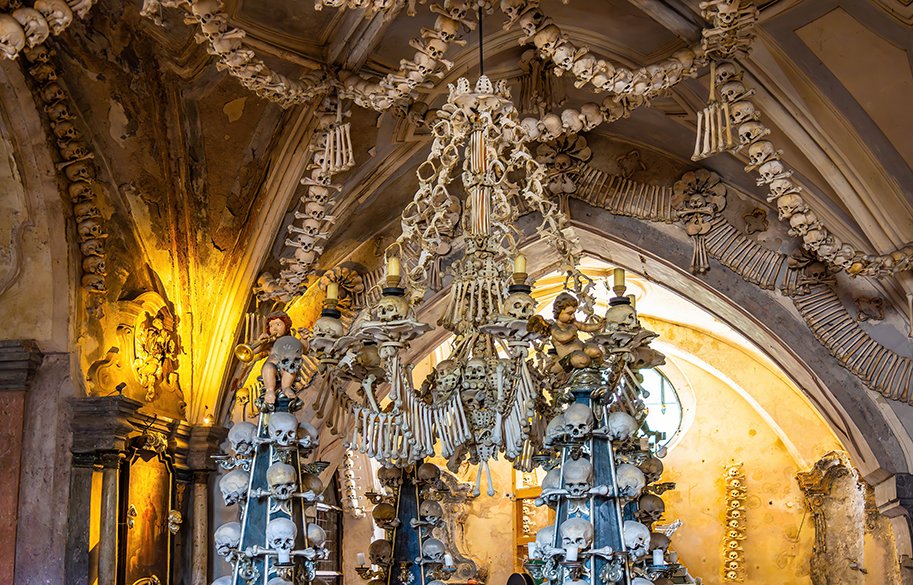
Rint did not simply stack the bones neatly. He disinfected and bleached them in chlorinated lime, then began arranging them into deliberate, elaborate decorations. The massive central chandelier, using at least one of every bone type found in the human body, became his signature achievement. He built two monstrances flanking the altar, garlands of skulls strung along the ceiling, and four towering bone mounds in the chapel’s corners. His most famous single piece is a complete coat of arms belonging to the Schwarzenberg family, rendered entirely in human bone.
Rint signed the work when he finished, spelling his own name out in bone on a wall near the entrance. Elsewhere in the chapel, someone arranged bones to spell out the phrase Ecce Mors, Latin for “behold death.”
The Sedlec Ossuary now sits as part of a UNESCO World Heritage designation alongside the historic center of Kutná Hora. It draws roughly 200,000 visitors a year, most arriving on the hour-long trip out from Prague. Despite the subject matter, many visitors describe the space as strangely peaceful rather than frightening, a quiet, deliberate meditation on mortality rather than a haunted house.
Recent Podcast Episodes

Recent Adventures



Subscribe Today!
Subscribe
Your Ad Here!

Other Adventures You May Like

The Berners Street Hoax Buried One London Address in Unwanted Deliveries

Nils Olav, the Penguin the Norwegian Army Keeps Promoting
