
The SS Eastland: Chicago’s Forgotten Disaster That Killed More People Than the Titanic Lost From Chicago
On the morning of July 24, 1915, a passenger steamship capsized in downtown Chicago. It never left the dock. The water beneath it was barely 20 feet deep. Its bow sat a mere 19 feet from the wharf. More people died that morning than died as passengers aboard the Titanic three years earlier. Almost nobody outside Chicago remembers it happened. This was the SS Eastland, and it remains the deadliest single shipwreck disaster in American history.
A Festive Morning That Turned in Minutes
Thousands of employees from the Western Electric Company gathered at the dock early that morning. They dressed for a company picnic across Lake Michigan in Michigan City, Indiana. Owners had chartered five excursion boats to carry them. Families came along. Children came along. One latecomer had to leap aboard the Eastland as crew hauled in the gangplank at 7:18 a.m.
By the time the ship reached full capacity, 2,573 passengers and crew stood crowded on its decks. The mood was festive despite the cool, damp weather. Nobody suspected anything was wrong until the ship started rocking.
A Ship That Was Never Actually Safe
The Eastland had been unstable for years, and people in a position to know had already said so. Builders launched the ship in 1903, designed to carry 650 passengers. A major retrofit in 1913 supposedly raised that capacity to 2,500, adding decks and structural weight far above the waterline. That same year, a naval architect warned officials directly that the ship needed structural repairs or a serious accident was likely. Nobody fixed it.
Then came an unrelated tragedy that made things worse. After the Titanic sank in 1912, the United States passed new legislation requiring passenger ships to carry more lifeboats. The law hadn’t fully taken effect yet, but the Eastland’s owners began complying early. They mounted eleven lifeboats and 37 life rafts, each weighing around 1,100 pounds, high on the ship’s upper decks. During debate over that very law, an executive from a rival shipping company issued a warning. Great Lakes vessels with shallow drafts, he said, could “turn turtle” if operators piled that much extra weight up top. Too few people listened. A safety measure created specifically to prevent another Titanic helped sink a ship in a Chicago river instead.
Rolling Over at the Dock
The Eastland began listing first to one side, then the other, as the crowd settled in. It briefly steadied. Then, as the boat neared full capacity, the rocking started again, worse this time. A piano slid across the promenade deck. A refrigerator toppled over. Dishes crashed off shelves. Water began pouring in through open portholes on the lower side of the hull.
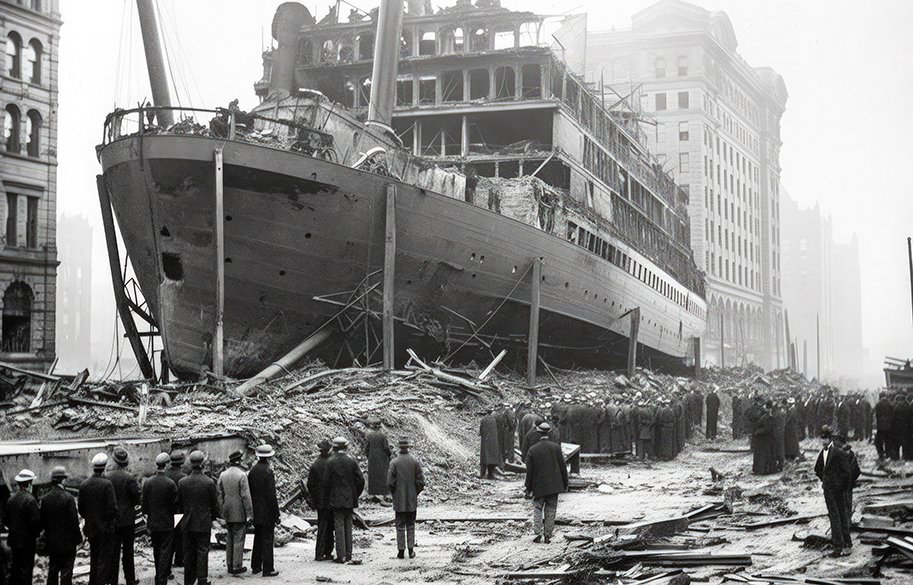
Passengers panicked as the tilt grew severe enough that people started sliding across the floor. Captain Harry Pedersen sounded the alarm, but not soon enough to matter. Crews never lowered a single lifeboat. Nobody launched the life rafts. Nobody handed out a single life jacket. All that new safety equipment, installed specifically because of the Titanic, sat completely unused as the Eastland rolled all the way over. It came to rest on its side in the mud of the Chicago River, still tied to the dock.
The Rescue and the Reckoning
Rescuers worked fast, cutting through the exposed hull with torches to reach people trapped inside. They pulled around 40 survivors out alive that way. More than 800 others did not make it out. Some died from blows to the head as furniture and bodies slid across the tilting decks. Many drowned. Sliding people and debris crushed or suffocated others beneath their weight.
Police divers spent the following hours and days pulling bodies from the river. It was a task grim enough that at least one diver reportedly broke down entirely from what he was seeing. City workers strung nets across sections of the river specifically to stop bodies from drifting out into Lake Michigan. Twenty-two entire families died together that morning. Roughly 175 women became widows before lunchtime, three of them pregnant. Eighty-four men lost their wives the same way.
An estimated 500,000 people reportedly came out to see the wreck over the following days, crowding bridges and riverbanks for a look. Some boat owners charged onlookers a small fee to ferry them past the capsized hull for a closer view. By the following Wednesday, Chicago had become a city consumed by funerals. So many services were scheduled at once that the city ran short of hearses. Marshall Field and Company, the department store, loaned 39 delivery trucks to help transport caskets across the city.
Almost Nobody Was Held Responsible
Federal prosecutors eventually charged several individuals connected to the ship, including its captain and company officials. The case dragged on for years. Famed defense attorney Clarence Darrow represented the accused. The case moved from Chicago to Grand Rapids, Michigan, where the defense believed they would find a friendlier jury. In the end, nobody involved in the disaster was ever criminally convicted.
Crews raised the ship itself from the river on August 14, 1915. Two years later, the Navy purchased it, renamed it the USS Wilmette, and converted it into a training vessel. That was a strange second life for a ship that had killed more of its own passengers than the most famous maritime disaster in modern history.
So, Why Aren’t We Talking About It?
The Eastland disaster killed more people than died as passengers on the Titanic. Yet the Titanic remains one of the most recognizable disasters in the world, while the Eastland barely registers outside Chicago. Part of the reason likely comes down to who was aboard each ship. Titanic carried some of the wealthiest, most prominent people of the era, alongside immigrants in steerage. Their deaths generated global headlines and lasting fascination. The Eastland carried factory workers and their families heading to a company picnic. Those were ordinary people, whose deaths, however numerous, simply didn’t command the same lasting cultural attention.
There’s also the setting itself. The Titanic sank in the middle of the Atlantic Ocean, a dramatic, remote, almost mythic backdrop. The Eastland rolled over at a dock, in a river, in the middle of a working city. People on the street could watch it happen in real time. Somehow that made it feel smaller in the retelling. In terms of raw human loss among passengers, though, it wasn’t smaller at all.
Recent Podcast Episodes

Recent Adventures



Subscribe Today!
Subscribe
Your Ad Here!

Other Adventures You May Like

The Berners Street Hoax Buried One London Address in Unwanted Deliveries

Nils Olav, the Penguin the Norwegian Army Keeps Promoting
