
The Tomb of the Giants: Sardinia’s Ancient Burial Monuments and the Myth That Named Them
Scattered across Sardinia, there are roughly 800 stone burial monuments locals call Tomba dei Giganti, tombs of giants. The name isn’t subtle. Whoever first stumbled on these things, centuries after they were built, looked at the sheer size of the stones. They decided only actual giants could have built them, or been buried inside. Nobody’s ever found a giant’s bone at any of these sites. What they have found is something arguably more interesting.
Bronze Age Engineering With No Instruction Manual Left Behind
These tombs belong to the Nuragic civilization, a Bronze Age culture that dominated Sardinia from roughly 1800 BC onward. They’re essentially the island’s signature form of ancient burial architecture. The design comes in two main styles. The earlier “slab type” uses large uncut stone slabs buried upright in a row. They’re all roughly the same height, except for one taller central stone marking the middle. Later, more elaborate versions added a curved, semicircular facade of standing stones out front. That facade wrapped around a central stele, marking the tomb’s actual entrance. Behind it sits a long, narrow burial corridor, originally covered over with smaller stones and earth to form a mound.
None of this happened by accident. Building one of these took real coordination and real labor. The stone-cutting skill involved would have been genuinely impressive, especially without any of the tools we’d consider standard today.
Why “Giants” Made Sense as an Explanation
Picture coming across one of these sites centuries later with zero written records to explain who built it. Some of the central steles at these tombs stand close to 13 feet tall, cut and positioned with real precision. The facade at one particularly large example, Li Lolghi, stretches roughly 56 feet across, made up of fourteen separate granite stones. Picture having no context for Bronze Age stonework, and no idea that the people who built this were entirely ordinary in size. “Giants must have done this” isn’t actually an unreasonable guess to land on. It’s just wrong.
Every excavation at these sites has turned up completely normal human remains. Regular-sized people were buried together there, generation after generation. These structures were built specifically to hold many bodies over time, rather than a single person. The tombs earned their nickname purely from scale, not from anything found inside them.
One detail makes these tombs more than just big piles of impressive rock. Look at the curved facade and central stele from above. The whole layout starts to resemble a bull’s head, with the semicircular row of stones fanning out like horns. That’s not accidental symbolism, most likely. The bull carried real religious weight for the Nuragic people, tied to ideas of masculine divinity and fertility. If that interpretation holds, these weren’t just tombs. They were built to look like something the people burying their dead there actually worshipped.
The Civilization That Built Them Left Its Mark Everywhere
They’re best known for nuraghi, the conical stone towers scattered across Sardinia by the thousands. Those towers actually gave the whole civilization its modern name. Giants’ tombs almost always show up near these settlements, suggesting the burial sites weren’t isolated sacred ground far from daily life. They sat close to where people actually lived and worked. Communities also gathered water at sites like the sacred wells found throughout the island, places tied to their own water-related rituals. Death, in other words, stayed physically near the community rather than getting pushed off to some separate, distant location.
That closeness matters for understanding what these tombs likely meant. A collective grave sitting a short walk from your own home isn’t just a burial site. It’s a constant, visible reminder of the people who came before you. It stayed embedded directly into daily life, rather than something visited only on special occasions.
Three Sites Worth Actually Knowing By Name
Coddu Vecchiu, near the town of Arzachena, ranks among the best-preserved examples anywhere on the island. It dates to around 1700 BC, built from granite, fronted by a roughly 13-foot stone slab. Archaeologists formally excavated it in 1966. Today it sits surrounded by vineyards, including the well-regarded Capichera winery nearby, a strange but genuinely lovely juxtaposition of ancient burial ground and modern wine country.
Li Lolghi, also near Arzachena, counts as one of the largest Tombs of Giants in Sardinia. Its construction wasn’t a single event either. The original structure may date back as far as 1800 BC. The burial corridor visitors see today was actually rebuilt sometime between 1400 and 1100 BC. That’s multiple centuries of a community returning to the same sacred ground, expanding and rebuilding rather than starting fresh somewhere else.
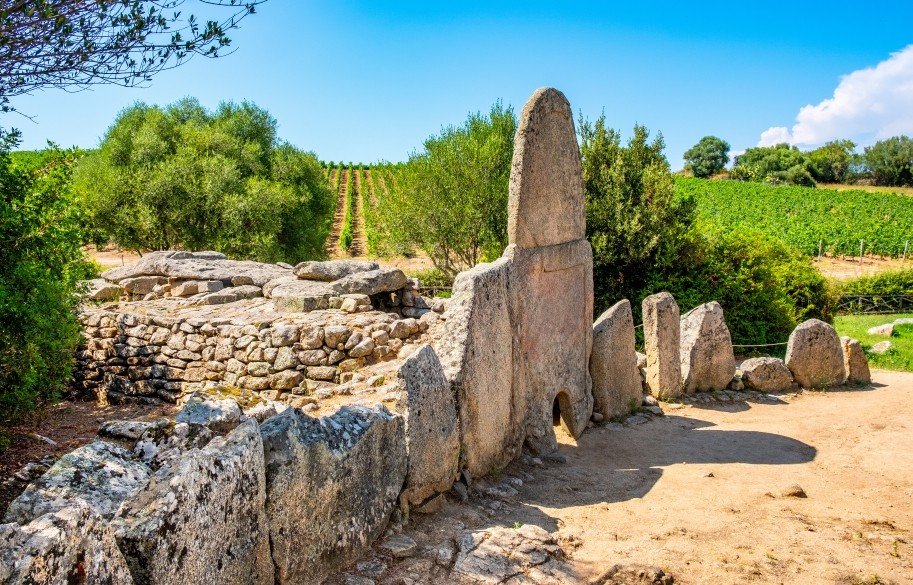
Su Mont’e s’Abe, near Olbia, tells an even more layered story. It started as a simpler covered gallery tomb during an earlier cultural phase. Then, around 1600 BC, it got transformed into a full Tomb of Giants. Builders deliberately reshaped it into that bull’s-head layout, complete with a 13-foot central stele holding a small entrance opening at its base. The interior burial chamber runs about 33 feet long, and the whole structure today stretches roughly 92 feet, making it one of the largest on the island. Here’s the part that genuinely puzzles archaeologists, though. Clear evidence shows sacred rites were performed there. Yet none of the usual funerary objects that typically accompany deceased individuals toward the afterlife ever turned up at the site. Whatever ritual actually happened there left behind almost no physical trace of what it involved.
A Mystery That May Never Fully Close
The Nuragic civilization never developed a system of writing, or at least never left any behind that survived. That means every theory about what these tombs actually meant comes from archaeology and educated guesswork, not anyone’s own recorded words. What rituals happened inside them, what the bull symbolism was really meant to communicate, all of it stays genuinely open to interpretation. Some modern visitors have layered their own beliefs on top of that mystery too. The tomb near Mizzani, close to Palau, has become something of an informal pilgrimage site. People convinced the stones there hold some kind of natural magnetic energy still show up looking for it. Archaeologists have found nothing to support that particular claim. But the fact that people keep coming anyway says something about how much raw mystery these places still radiate, thousands of years after they were built.
What’s actually there is simpler, and somehow just as compelling. Ordinary Bronze Age families built these structures, without a single written word left behind to explain themselves to us. What they built was massive enough to convince later generations that giants must have lived among them. They didn’t. They just cared enough about their dead, and about each other, to build something built to last.
Recent Podcast Episodes

Recent Adventures



Subscribe Today!
Subscribe
Your Ad Here!

Other Adventures You May Like

The Berners Street Hoax Buried One London Address in Unwanted Deliveries

Nils Olav, the Penguin the Norwegian Army Keeps Promoting
