
The Tulsa Race Massacre: What Actually Happened to Black Wall Street in 1921
For two days in the spring of 1921, a white mob destroyed one of the most prosperous Black communities in the United States. It’s now referred to as the Tulsa Race Massacre. Historians now believe as many as 300 people died. The city covered up the scale of it for decades. Survivors spent the rest of their lives fighting for any real acknowledgment. The last of them died in 2025, still waiting.
Greenwood Built Something Real
Black Americans founded the Greenwood District in Tulsa, Oklahoma, starting around 1906, on land that had recently been Indian Territory. Within about fifteen years, it grew into a genuine economic powerhouse. Grocery stores, hotels, law offices, a hospital, a newspaper, theaters. Locals called it Black Wall Street, and the name wasn’t hype. It was one of the most affluent Black communities anywhere in the country. People built it almost entirely from nothing, in a deeply segregated state.
It Started With an Elevator and a Scream
On May 30, 1921, a young Black shoeshiner named Dick Rowland got into an elevator at the Drexel Building. A white elevator operator, Sarah Page, was running it. What actually happened inside that elevator has never been fully established. At some point, Page screamed, and Rowland fled. Police arrested him the next morning.
The Tulsa Tribune printed an inflammatory account of the incident that same afternoon. It hinted at an alleged assault and, according to multiple accounts, a planned lynching. Tension built fast through the evening. Armed white and Black groups gathered near the courthouse where Rowland was being held. Shots broke out. Nobody has ever pinned down who fired first, but it didn’t matter after that. The night turned into something else entirely.
A Mob Burned 35 City Blocks to the Ground
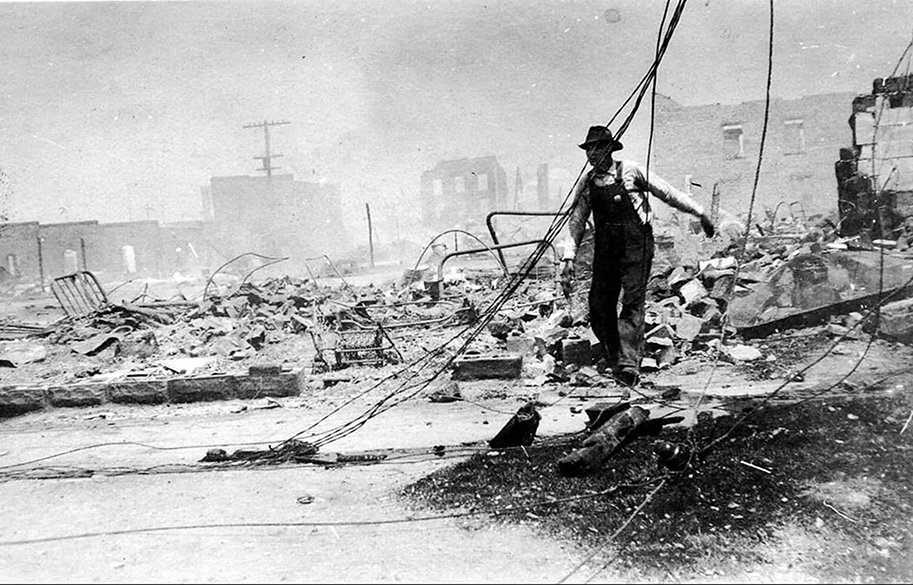
In the early hours of May 31 into June 1, white rioters swept through Greenwood. Many were World War I veterans with real firearms training. Some had been deputized by local police that same night, and handed weapons. They looted homes and businesses first, then burned what they’d looted.
Accounts from survivors and later investigations describe something even more disturbing. Private airplanes reportedly flew low over Greenwood, allegedly dropping firebombs and shooting at residents trying to flee below. If accurate, it stands as one of the only documented aerial attacks on American civilians carried out on domestic soil.
By the time it ended, more than 1,400 homes and businesses across some 35 city blocks lay in ashes. Nearly 10,000 people had nowhere left to live. Officials at the time recorded only 36 deaths. A state commission investigating the massacre decades later, in 2001, concluded the real number likely fell between 100 and 300. Most historians today cite figures closer to 300.
The National Guard Arrived, Then Locked Up the Victims
Oklahoma’s governor declared martial law once the violence spiraled out of control. The National Guard moved in to help put out fires and stop the mob. But guardsmen also rounded up thousands of Black Tulsans who’d survived the attack. They held more than 6,000 people at internment sites like Convention Hall and the local fairgrounds. Some stayed detained for over a week, with nowhere to return to even after they were finally released.
The City Started Digging for Mass Graves
The uncertainty around the death toll wasn’t just a historical footnote, either. Survivors and researchers had long suspected the city buried massacre victims in unmarked mass graves. In 2020, Tulsa finally began excavating sites identified through historical records and ground-penetrating radar. Crews at Oaklawn Cemetery uncovered multiple mass burials containing remains consistent with gunshot trauma. It was exactly the kind of physical evidence survivors had described for a century, without anyone in power acting on it. The excavations have continued in phases since then. Identifying the individual victims through DNA analysis remains painfully slow, given how much time has passed and how few records connect names to remains.
The City Buried the Story for Decades
What happened in Greenwood barely appeared in history books for most of the twentieth century. Oklahoma didn’t require public schools to teach the massacre until 2000, and it didn’t extend to U.S. history courses statewide until 2004. A proposed bill requiring every Oklahoma high school to specifically teach it failed to pass as late as 2012.
Greenwood’s residents rebuilt anyway, without much outside help. By the end of 1922, roughly 80 new businesses had already reopened in the district. The community kept functioning through much of the century that followed. The truth of what had happened to it stayed largely buried outside Tulsa itself the whole time.
Survivors Spent Their Final Years Still Fighting
By the massacre’s centennial in 2021, only three known survivors remained. Viola Fletcher, her brother Hughes Van Ellis, and Lessie Benningfield Randle were all over 100 years old. Fletcher testified before Congress that May, describing what she still carried from that day as a seven-year-old child. She told lawmakers she could still see Black men being shot and Black bodies lying in the street. She still smelled the smoke. She still heard the screams.
The three survivors sued the city of Tulsa in 2020, seeking reparations under Oklahoma’s public nuisance law. A county judge dismissed the case in 2023. Van Ellis died that same year at 102. The survivors appealed. In June 2024, the Oklahoma Supreme Court dismissed the case for good. Harm from a century-old event, the court ruled, didn’t meet the legal bar for an ongoing public nuisance.
A Department of Justice review conducted under the Emmett Till Act later confirmed what survivors had said for a hundred years. The massacre was a coordinated, military-style attack, the review concluded. It found no legal path left to prosecute anyone, this far removed from 1921.
Viola Fletcher died on November 24, 2025, at age 111. She was the last living witness to what Greenwood actually lost that night. She spent more than a century wanting exactly one thing nobody in power ever gave her while she was alive. She wanted the country to actually admit what happened, and do something real about it.
Recent Podcast Episodes

Recent Adventures



Subscribe Today!
Subscribe
Your Ad Here!

Other Adventures You May Like

The Berners Street Hoax Buried One London Address in Unwanted Deliveries

Nils Olav, the Penguin the Norwegian Army Keeps Promoting
