
The Winter War: How Finland Held Off the Soviet Invasion Everyone Expected to Lose Fast
On November 30, 1939, the Soviet Union invaded Finland. Stalin expected the whole thing wrapped up within a couple of weeks, and on paper that was a reasonable assumption. The Red Army outnumbered the Finns four to one in soldiers. It had roughly a hundred tanks for every one Finland could field, and thirty aircraft for every Finnish plane. The war lasted 105 days. Finland lost, technically. But what happened in those three and a half months rearranged how the world understood Soviet military power. The consequences of that reached all the way to 1941.
Why the Soviets Came
The Soviet demands centered on security. Leningrad sat only about 20 miles from the Finnish border. Moscow wanted Finland to hand over substantial territory near that frontier, offering land elsewhere in exchange. Finland refused. So the Soviets invaded. The League of Nations declared the attack illegal, and expelled the Soviet Union on December 14, 1939.
Stalin also had a political plan ready. On December 1, the day after the invasion began, the Soviets installed a puppet government. They set it up in the captured Finnish border town of Terijoki, called it the Finnish Democratic Republic, and put Otto Ville Kuusinen at its head. Moscow recognized it immediately. The hope was that Finnish socialists would defect to it. Almost nobody did. The Terijoki government accomplished essentially nothing before being quietly folded into a Soviet republic in March 1940.
Finland Fought the War the Terrain Allowed
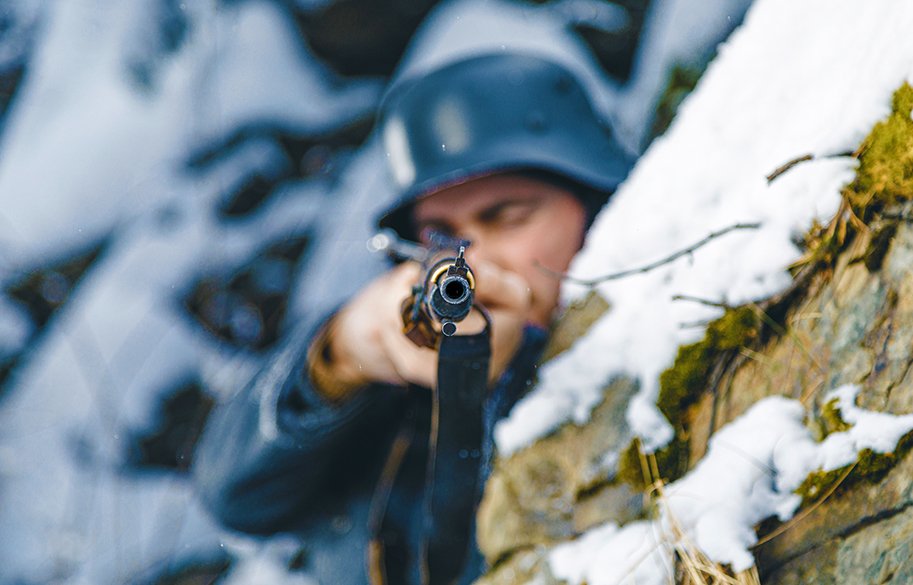
Finland mobilized roughly 180,000 troops. It had almost no tanks and fewer than a hundred aircraft. So Finnish commanders built their strategy around the one advantage they actually had, which was knowing the ground. Soviet columns depended on the few roads cutting through dense forest. Armor could be heard coming from kilometers away. Finnish ski troops, dressed in white camouflage, moved almost silently through the trees. Finnish units also used reindeer to drag machine guns and mortars into position without making noise.
Out of this came the tactic the Finns called motti. The word refers to a stack of firewood, and the method matched the name. Finnish units would cut a long Soviet column into isolated pockets. Then they severed those pockets from each other and destroyed them one at a time, over days of small engagements. Temperatures during much of this dropped past minus 40 degrees. Soviet troops, many from warmer regions and poorly equipped for the conditions, stood out sharply against the snow.
Suomussalmi and the Raate Road
The clearest demonstration came at Suomussalmi, fought between December 1939 and January 1940. Colonel Hjalmar Siilasvuo’s 9th Division faced two full Soviet divisions, the 163rd and the 44th, totaling more than 45,000 men. The Finns destroyed both. Estimates put Soviet dead around 13,000. Finland lost roughly 900 men. Finnish forces also captured 50 tanks, 1,300 vehicles, and 37 artillery pieces.
The 44th Division was a motorized unit from Ukraine, sent to relieve the trapped 163rd. Finnish troops cut it into pockets along the narrow Raate Road and eliminated them methodically. Soviet General Vinogradov abandoned the battlefield on skis, leaving his men behind. A Soviet court-martial later had him shot in front of his surviving troops. Further north at Kollaa, roughly 4,000 Finnish soldiers held a river line against Soviet forces that eventually numbered over 130,000. They held it for more than three months. Finnish radio broadcast the same two words throughout the war: Kollaa holds.
Why the Red Army Performed So Badly
The gap between Soviet strength on paper and Soviet performance in the field needs explaining, because the numbers really were overwhelming. Part of it was preparation. Soviet planners expected a short campaign against a minor opponent, so units arrived without adequate winter equipment, without white camouflage, and without much sense of the terrain they were entering. Tanks and motorized columns stuck to roads because the forest gave them no other option, which made them predictable targets.
The deeper problem was leadership. Stalin’s purges through the late 1930s had gutted the Soviet officer corps, removing experienced commanders on a scale that left units under men with limited command experience. Initiative was dangerous in that environment. Officers who improvised risked being accused of something worse than failure, so many followed orders that no longer fit the situation in front of them.
General Vinogradov’s fate after the Raate Road illustrates the atmosphere precisely. He abandoned his command, which was inexcusable. But the response, executing him in front of his surviving soldiers, tells you what kind of army the Finns were actually facing.
The Sniper Everyone Remembers
The war’s most famous figure was a farmer named Simo Häyhä. He was 34 when it started and stood 5 feet 3 inches tall. He had spent his life hunting in the forests of Karelia. Häyhä used a standard bolt-action rifle, the M/28-30, without a telescopic sight. He filled his mouth with snow so his breath wouldn’t steam and give away his position. Soviet troops called him Belaya Smert, the White Death, and they sent counter-snipers and directed artillery specifically at his positions.
The commonly cited figure is more than 500 kills in under 100 days. That number deserves a caveat, though. Häyhä wrote a private memoir in 1940 estimating “around 500.” His family kept it hidden for 77 years, until Finnish historians found it in 2017. But Finnish military historian Risto Marjomaa has argued that wartime propaganda substantially inflated the figure. Confirming body counts under those conditions was also genuinely difficult.
On March 6, 1940, a Soviet sniper shot Häyhä in the jaw with an explosive bullet. The war ended six days later. He survived. Reconstructive surgery took years. He returned to farming, though his home region had become Soviet territory under the peace treaty, forcing him to relocate. He hunted moose into his eighties and gave almost no interviews about the war. He died in 2002 at 96.
Molotov’s Bread Baskets
One piece of Soviet propaganda backfired permanently. Soviet bombers dropped cluster munitions on Finnish cities. Foreign Minister Vyacheslav Molotov then claimed on the radio that the planes were delivering food to starving Finns. The Finns found this grimly funny. They started calling the bombs “Molotov bread baskets.” Then they named their improvised incendiary devices the “Molotov cocktail,” describing it as a drink to go with the food. That name has outlived nearly everything else about the war.
How It Ended
Overwhelming force eventually did what it usually does. In February 1940, the Soviets launched one of the largest artillery bombardments since World War I. They broke through Finnish defenses on the Karelian Isthmus.
Finland signed the Moscow Peace Treaty on March 13, 1940. The terms cost the country about 11 percent of its territory, including Vyborg, its second-largest city. Finland also lost roughly 20 percent of its industrial capacity. Finnish flags flew at half-mast in Helsinki. Entire towns in the east evacuated as the land changed hands. Finland counted 25,904 dead. Soviet losses ran to at least 126,875 killed, with some estimates reaching 180,000.
The Defeat That Cost the Soviets More
Nikita Khrushchev later described the mood among Soviet leadership in blunt terms. All of them, he said, Stalin first and foremost, sensed a defeat by the Finns inside their own victory. He was right in ways that mattered enormously. The war exposed the Red Army as far weaker than outside observers had assumed, and German intelligence took careful note. That assessment fed directly into Hitler’s planning for Operation Barbarossa, launched in June 1941.
The territory the Soviets won offered essentially no defensive advantage when that invasion came fifteen months later. From Moscow’s perspective, the Winter War produced two things. A strip of forest, and a reputation for weakness that helped convince Germany to attack. Finland lost the war and kept its independence. The Soviet Union won it and paid for that victory three years running.
Recent Podcast Episodes

Recent Adventures



Subscribe Today!
Subscribe
Your Ad Here!

Other Adventures You May Like

The Berners Street Hoax Buried One London Address in Unwanted Deliveries

Nils Olav, the Penguin the Norwegian Army Keeps Promoting
