
Tokyo’s Samurai Restaurant: Where Japanese Entertainment Gets Delightfully Out of Control
Somewhere in the tangled neon backstreets of Shinjuku, there’s a show involving cartwheeling samurai, breakdancing ghosts, and geisha pounding out rhythms on taiko drums. All of it happens inside the same 90 minutes. It’s called the Samurai Restaurant. It’s technically a restaurant. But almost nobody goes there for the food.
It’s Actually a Resurrection
To understand this place, you first need to know about the Robot Restaurant, its legendary predecessor. For years, that show ran in the exact same Kabukicho neighborhood. It packed in neon lights, giant robots, dancers riding dragon boats, and mock battles loud enough to rattle your ribs. It became one of Tokyo’s most talked-about attractions. Then the pandemic hit, and it closed in March 2020, and never came back. One source even claims a mechanical malfunction quietly killed any hope of a comeback.
But the void didn’t last. In October 2023, the same producers opened the Samurai Restaurant in that exact same spot. So this isn’t really a copycat. It’s closer to a sequel, built by the people who made the original chaos in the first place.
Fewer Robots, Same Level of Madness
Here’s the twist nobody expects. Despite following in the footsteps of a show literally named after robots, the Samurai Restaurant actually has fewer of them. Instead, the show leans harder into live performance. Sword fights, dance battles, elaborate festival floats, and glowing-blade choreography that reviewers keep comparing to Power Rangers, minus any coherent plot holding it together.
That’s honestly part of the appeal. Figuring out what’s actually happening on stage is half the fun. One writer described the whole thing as “bonkers, in a great way.” Another simply said you never know what to expect next. Given the setting, that tracks completely.
Live musicians and dancers change costumes constantly throughout the performance, sometimes mid-scene. The set itself shifts between backdrops almost as fast as the action does. Reviewers who’ve seen both shows note the production values have actually gone up since the Robot Restaurant days. That’s despite a noticeably smaller stage to work with. Whatever the show lacks in robotics, it more than makes up for in raw commitment.
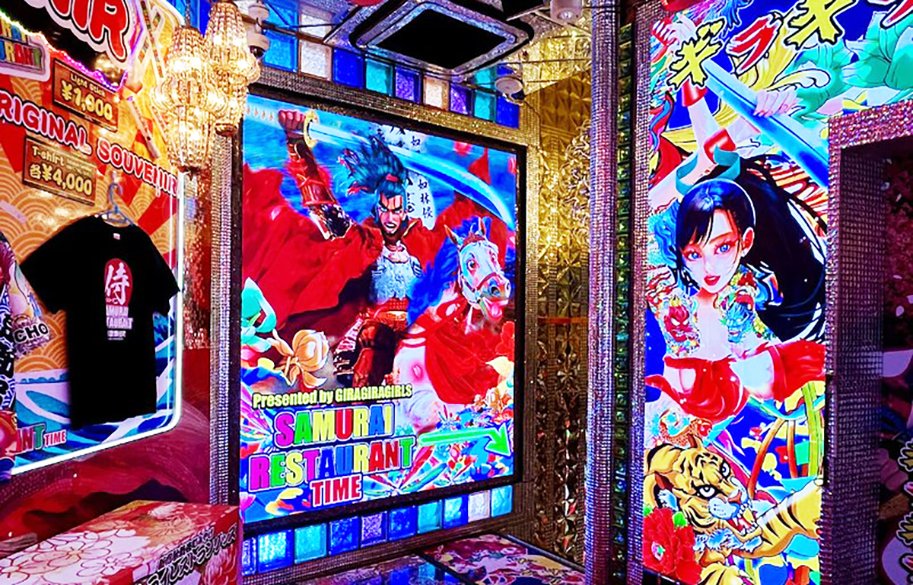
The Building Itself Sets the Tone Before the Show Even Starts
Getting inside is its own experience. Guests walk into a blindingly neon entrance room that feels almost mirrored, with light bouncing in every direction at once. A tall witch statue marks the spot outside, in case the noise and glow weren’t already a giveaway. Staff then lead visitors down a set of stairs that multiple reviewers describe as genuinely trippy, before the actual show even begins.
The venue sits inside the same building as Gira Gira Girls, an adult-oriented “girl’s bar.” That’s why the show itself is restricted to guests 18 and older. The performance itself contains no actual adult content, despite that neighbor. It’s loud, weird, and gleefully over-the-top, but PG at its core.
Even the Name Is a Little Misleading
Don’t come expecting a deep dive into real samurai history, either. This isn’t a cultural lecture. It’s a maximalist blender of Japanese pop culture, folklore, and festival imagery. Production value is genuinely impressive, historical accuracy is not really the point. That’s clearly on purpose. The whole point is spectacle, not a textbook.
Shows run three times daily, and tickets typically range from around ¥7,000 to nearly ¥15,000 depending on timing and season. The restaurant sits about a five-minute walk from Shinjuku Station’s East Exit. It’s tucked among some of Tokyo’s other iconic chaos too, including the Godzilla statue and the narrow, glowing alleys of Golden Gai.
Robot Restaurant is gone for good now, and its replacement never quite pretends to be the same show. But it clearly inherited the same instinct. Take everything wild about Japanese pop culture, throw it on one stage, and let the audience figure out the rest as they go.
Recent Podcast Episodes

Recent Adventures



Subscribe Today!
Subscribe
Your Ad Here!

Other Adventures You May Like

Nils Olav, the Penguin the Norwegian Army Keeps Promoting

A Guide to Caravan Sales in NSW for First-Time Buyers
