
Honoring Loss and Life: Our Day of the Dead Experience in Puerto Vallarta
Getting to experience the Day of the Dead in Mexico has been on my bucket list for as long as I can remember. As someone who’s spent years studying death rituals across cultures, I thought I understood the profound beauty of how different societies honor their dead. But understanding something intellectually and experiencing it with your whole heart are two very different things. I learned this last November in Puerto Vallarta.
When the Marriott in Puerto Vallarta graciously invited us to stay and participate in their Day of the Dead celebrations, I knew this would be more than just another documentary segment for Weird World Adventures. Michael and I were carrying something heavy with us on this trip: the loss of Marisa, Michael’s sister and my best friend, who had passed away in 2023. Neither of us could have anticipated how transformative this experience would become, or how a Mexican tradition would give us exactly what we needed to heal through celebration.
The warm beach air of Puerto Vallarta created an unexpected backdrop for contemplating mortality. Most people associate Mexican beaches with margaritas and mindless relaxation, but during Día de los Muertos, even the paradise takes on a different resonance. Death doesn’t feel morbid here, it feels like a natural guest at the table, something to be acknowledged, celebrated, even laughed with.
Our Day Out in Puerto Vallarta
Our immersion began with face painting at the Marriott, where skilled artists painted the traditional half-skull Catrina makeup on us. As the artist carefully painted delicate flowers and swirling patterns across my face, she explained that each design element carries meaning. “We don’t hide from death,” she told us. “We make it beautiful. We make it ours.”


Our next stop took us to the Malecón, Puerto Vallarta’s famous seaside boardwalk, to see what we’d been told was the world’s largest catrina in the world. Standing before this towering skeletal figure dressed in her elegant finery, I was struck by the defiant joy of it all. La Catrina, originally created by artist José Guadalupe Posada as political satire, has become the matriarch of Day of the Dead celebrations—a reminder that death comes for rich and poor alike, so we might as well dress up and make it interesting.


The cemetery visit changed everything for us. We arrived at a local cemetery where families were already gathered around graves, preparing elaborate altars for their departed loved ones. The Marriott had arranged for us to participate in a mini altar celebration, and we found ourselves learning the intricate process alongside Mexican families who’ve been doing this their entire lives.
“You bring their favorite foods,” we were told. “You bring marigolds to guide them home with the scent. You bring photos so they know they’re remembered. You bring candles so they can find their way in the dark.”

We watched families laughing, crying, eating together at gravesides, sharing stories about the people they’d lost. There was no hushed reverence, no somber black clothing. Children ran between graves holding sugar skulls. Someone was playing guitar. A grandmother was scolding her deceased husband’s photo about something while simultaneously arranging his favorite tamales on the altar.
This wasn’t grief as we’d been experiencing it, private, heavy, isolating. This was communal, colorful, and celebratory.

The parade started as the sun began to set. Black horses had been painted white with skeletal markings, their riders dressed in traditional costumes, creating this surreal procession that looked like it had stepped out of mythology itself. The horses moved through the streets with an otherworldly grace, their painted bones seeming to glow in the fading light.
Day of the Dead Ceremony at the Marriott Puero Vallarta

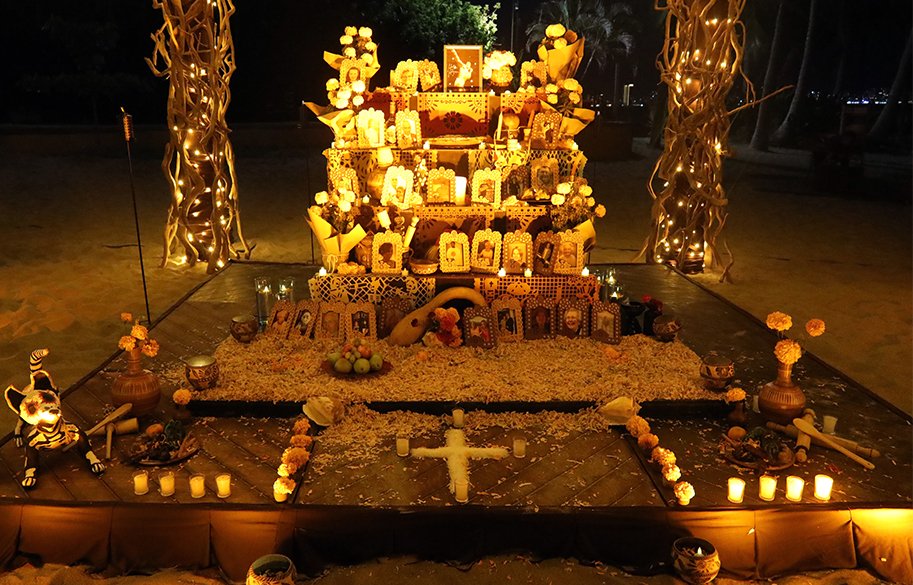
But the moment that will stay with me forever came during the Day of the Dead ceremony on the beach. The Marriott had created a beautiful communal altar space right on the sand, with the Pacific Ocean as a backdrop. They served traditional foods, tamales, pan de muerto (sweet bread of the dead), mole, champurrado and drinks, while explaining the significance of each element we were adding to the altar.
I was graciously invited to bring the tamales up onto the altar after the water was placed and prior to the tequila. And then it was time to make it personal to us.
When they invited guests to bring forward photos of their own loved ones to add to the altar, Michael and I looked at each other. They had given us a picture of Marisa, and Michael was given the chance to place it at the altar.

Placing Marisa’s photo on that altar, surrounded by marigolds, candles, and offerings, felt like we were finally giving our grief permission to exist outside our chests. But in a beautiful, positive celbration filled with love. The ceremony guide explained that during Day of the Dead, the veil between worlds grows thin, allowing spirits to return and visit those who remember them.
“They’re not gone,” one of the guests said. “They’re just in the next room. And tonight, the door is open.”
I’ve documented death rituals across the world, but there, on a Mexican beach with my face painted like a skull and my best friend’s photo glowing in candlelight, I wasn’t a journalist or researcher. I was just someone who missed someone, finding comfort in a tradition that understands grief doesn’t have to be carried alone.
Mexico’s Day of the Dead taught us something we desperately needed to learn: that death doesn’t have to separate us from those we’ve lost. That we can set a place at the table for them, tell their stories, laugh at their jokes, get angry at their stubbornness, and keep them woven into our lives. Not despite their death, but because of our love.
As we walked back to our room that night, still wearing our face paint, I deeply understood why this celebration has persisted for thousands of years. It’s not about forgetting pain or pretending loss doesn’t hurt. It’s about making space for the dead among the living, acknowledging that love doesn’t end just because life does.
Thank you, Marisa, for giving us a reason to be there. And thank you, Mexico, for showing us how to carry her forward.
Recent Podcast Episodes

Recent Adventures



Subscribe Today!
Subscribe
Your Ad Here!

Other Adventures You May Like

Nils Olav, the Penguin the Norwegian Army Keeps Promoting

The Mount Washington Cog Railway Has Been Climbing New Hampshire’s Tallest Peak Since 1869
