
The Oni, the Tanuki, and the Kappa: A Deep Dive Into Japanese Yokai Folklore
I have been obsessed with Japanese folklore since before it was cool to be obsessed with Japanese folklore, and I will not be taking questions.
Yokai are supernatural creatures from Japanese mythology, and the word itself translates roughly to “strange apparition.” It covers everything from terrifying demons to mischievous raccoon dogs to murderous river creatures with bowls on their heads. The range is extraordinary. Some yokai will drag you to hell. Some will play a prank on you and steal your sake. And some will do both.
The three I want to talk about today are the ones that show up everywhere once you start looking: in festivals, in architecture, outside restaurants, in every anime you’ve ever watched. The oni, the tanuki, and the kappa. Each one is stranger and more interesting than most people realize.

What Even Are Yokai?
Before getting into the specific creatures, it helps to understand what yokai actually are and what they’re doing in Japanese culture.
Yokai are not exactly demons in the Western sense. They’re not angels either. They sit in this category of supernatural beings that embody human fears, natural phenomena, moral concepts, and sometimes just the feeling that something weird is going on in the woods tonight.
They come in different types: animal spirits, human transformations, household objects that gain consciousness after existing for a hundred years (which is called tsukumogami and is one of my favorite concepts in any folklore tradition), and nature spirits that inhabit mountains and rivers and trees.
The point is that Japanese folklore doesn’t really have a clean division between the natural and supernatural world. The two are constantly bleeding into each other, and yokai are what live in the gaps.
The Oni: More Complicated Than Just a Demon
The oni is probably the most recognizable yokai outside of Japan. Big horned creature, usually red or blue skin, carrying a massive iron club, wearing a tiger-skin loincloth. You’ve seen it on everything from festival masks to tattoos to anime.
The original concept, drawn from Chinese cosmology and imported into Japan, referred to formless spirits of illness and disaster. You couldn’t see them but you could feel their effects: disease, misfortune, things going wrong for no apparent reason.
When Buddhism arrived in Japan around the 6th century, the oni got a body. Buddhist teachings brought with them a fully developed cosmology of hell, and the oni became the jailers and torturers of the damned, working under Emma-O, the King of Hell. They took on the massive, muscular, horned physical form we know today.
By the Heian period (794 to 1185 AD), the oni was a fully formed cultural figure. It had a specific direction it came from, the northeast, which in Japanese cosmology was called the kimon or “demon gate.” Temples were actually built facing northeast specifically to guard against oni. Kyoto’s famous Enryaku-ji temple on Mount Hiei was deliberately positioned there to protect the capital.
Oni Are Not Simply Evil
Here’s what most people don’t know about oni: they are not just villains. Yes, they kidnap people and eat them in old folktales. Yes, they represent chaos and destruction. But in Buddhist stories, oni are also agents of karmic justice. They don’t just attack anyone. They come for the wicked. A person who was truly terrible in life could actually transform into an oni after death, which means every oni you see in folklore is essentially walking, horned evidence of someone’s past sins.
Some stories show oni converting to Buddhism after encountering a compassionate monk. Some depict them as guardians of temples once they’ve been shown kindness. The oni is one of those figures that reflects a distinctly Japanese idea: that good and evil are not fixed states, and even the most monstrous thing might be capable of something else.
The Tanuki: A Real Animal With an Absurd Mythology
The tanuki is a real creature. It’s a Japanese raccoon dog, native to East Asia, and it looks like someone asked a raccoon and a dog to collaborate on a design without communicating with each other. Shy, nocturnal, and genuinely cute. That’s the actual animal.
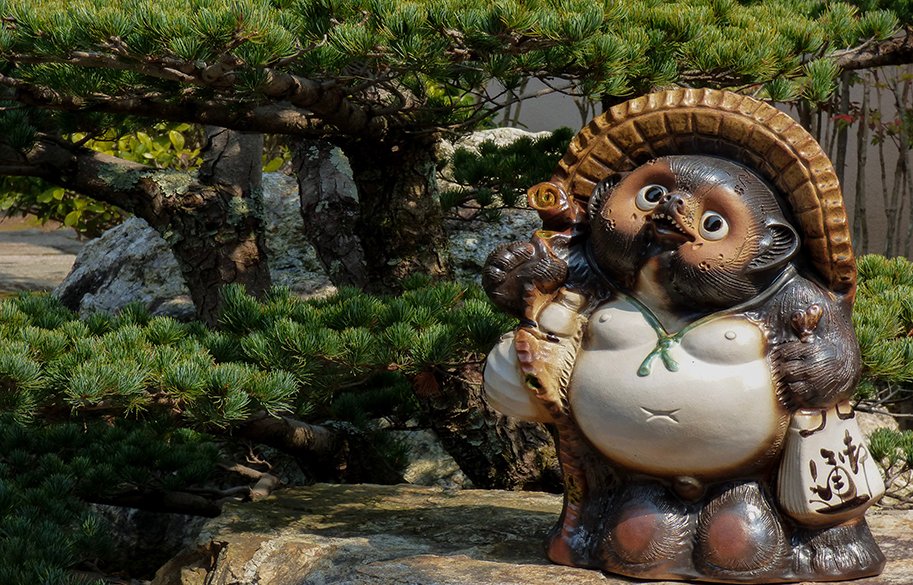
In Japanese folklore, the tanuki is a master of disguise who uses its powers mostly for mischief. It transforms into humans, objects, and other animals, usually to buy sake, gamble, or embarrass someone who annoyed it. Unlike the kitsune (fox spirit), which transforms for calculated purposes of seduction and manipulation, the tanuki transforms for fun and personal benefit. It’s not sinister. It’s just kind of a mess.
The tanuki appears in some of Japan’s oldest historical texts. The Nihon Shoki, written in 720 AD, includes accounts of tanuki transforming into humans and singing songs, which is a delightful sentence to find in an ancient historical document.
The Kappa: The One You Should Actually Be Afraid Of
The kappa is, in my personal opinion, the most unhinged yokai in the entire tradition, and I mean that with complete affection.
Kappa are aquatic creatures that live in rivers, streams, and waterways across Japan. They look vaguely humanoid but with reptilian or amphibian features: scaly skin, a beak like a turtle, webbed hands, and a shell on their back. Their skin can range from green to blue to yellowish. They’re roughly child-sized.
The defining feature is a dish-like indentation on the top of their head that holds water. This is their power source. If the water spills out of the dish, the kappa loses all its strength and is essentially helpless until it gets refilled.
What the Kappa Actually Does
Historically, the kappa was genuinely feared as a dangerous water creature. It dragged people into rivers and drowned them. It targeted children especially, which is why parents in the Edo period would throw cucumbers with their children’s names written on them into rivers as offerings, hoping to keep the kappa appeased for at least another year.
The kappa also supposedly extracted a mythical organ from its victims through a method that I will describe only as: from behind. This organ, called the shirikodama, was believed to contain the soul. The kappa would remove it from drowned victims, which supposedly explained the physical signs of drowning in ways that felt supernatural to people at the time.
Kappa have an obsessive love of cucumbers. This is fully canonical in Japanese folklore. They like cucumbers more than human flesh. Which is why you can appease one with a cucumber offering and why cucumber sushi rolls are called kappa maki.
Recent Podcast Episodes

Recent Adventures



Subscribe Today!
Subscribe
Your Ad Here!

Other Adventures You May Like
The Real Monsters of the Odyssey, and What They Might Have Actually Been
Forest Fairies: Why So Many Cultures Believe Something Magical Lives in the Woods
