The Vera Rubin Observatory: The New Telescope Built to Photograph the Entire Night Sky Every Few Days
A single image from this telescope is big enough that displaying it at full resolution would require 400 separate 4K television screens, lined up together. That’s one photo. This particular observatory plans to take millions of them. It will repeatedly scan the entire visible night sky every few nights, for the next ten years straight.
A Telescope Built Around One Enormous Camera
The Vera C. Rubin Observatory sits atop Cerro Pachón in Chile. It’s a joint project of the U.S. National Science Foundation and the Department of Energy, and it cost roughly $810 million to build. At its center sits the Simonyi Survey Telescope, an 8.4-meter instrument paired with something genuinely unprecedented: the LSST Camera, the largest digital camera ever built for astronomy.
The camera alone took nearly two decades to build and involved hundreds of scientists across the globe. It weighs more than 3,000 kilograms, roughly the size of a small car but about twice as heavy. It captures images at 3,200 megapixels, somewhere around the combined resolution of 260 modern smartphone cameras. Engineers finished building it in April 2024, then carefully transported it to Chile and installed it on the telescope in March 2025.
A Placement That Had to Be Precise to the Millimeter
Installing the camera wasn’t just a matter of bolting it into place. The camera’s field of view spans an extremely wide 3.5 degrees. Even a tiny placement error would ruin every image it took, turning sharp points of starlight into blurry donuts of light instead. The team positioned the camera within about three millimeters of its ideal location relative to the telescope’s mirrors. That’s a genuinely remarkable feat of precision engineering for an instrument this large.
That patience paid off. On June 23, 2025, the observatory unveiled its first images to the world. The event happened at the National Academy of Sciences in Washington, D.C., with watch parties happening simultaneously around the planet. One of the very first released images combined 678 separate exposures, adding up to just over seven hours of observing time. It revealed the Trifid and Lagoon Nebulae in extraordinary, previously invisible detail, clouds of gas and dust several thousand light-years away rendered with a clarity nobody had captured quite this way before.
Getting There Took Years of Smaller Milestones
None of this happened suddenly. Nearly a year before the LSST Camera ever captured its first image, engineers ran an entirely separate test using a smaller, lower-resolution stand-in called the Commissioning Camera. On October 30, 2024, that practice camera successfully captured its first on-sky data and transmitted it from the observatory in Chile back to the U.S. Data Facility at SLAC National Accelerator Laboratory in California. The mood in the control room that day was reportedly electric. It marked the first time light had actually traveled through the telescope’s full optical system and produced a usable image. That was proof years of construction had resulted in a genuinely functioning instrument, even before the far more complex full-resolution camera was ready to take over.
Officials overseeing the project haven’t been shy about the scale of what they expect Rubin to eventually deliver. One senior NSF official put it bluntly: the observatory is expected to capture more information about the universe than every optical telescope throughout history combined. That’s not a modest claim, and it’s also not an exaggeration once you account for the sheer volume of sky Rubin will cover, night after night, for a full decade.
Photographing the Entire Sky, Over and Over
The observatory exists to run a single, enormously ambitious science program called the Legacy Survey of Space and Time, or LSST, for short. Over the course of ten years, Rubin will repeatedly scan the entire visible southern sky roughly every three to four nights. Scientists describe the result as an ultra-wide, ultra-high-definition time-lapse movie of the universe. Each individual exposure lasts about 40 seconds and covers an area of sky equal to roughly 45 full Moons at once.
Once fully operational, the observatory will generate approximately 20 terabytes of new data every single night. Dedicated computing facilities process that flood of information in real time. Whenever the system detects something that’s changed since the last pass, it can issue an alert to astronomers worldwide within minutes. That kind of speed matters enormously for catching short-lived cosmic events: an exploding star, a newly discovered asteroid, anything that wouldn’t stick around long enough for a slower, more traditional telescope to notice in time.
What Scientists Actually Hope to Find
Rubin’s science goals span an enormous range. Researchers expect the survey to sharpen our understanding of dark matter and dark energy, the mysterious components that appear to make up most of the universe’s actual mass and expansion. It will catalog vast numbers of asteroids and comets much more thoroughly than any previous survey has managed. It will catch supernova explosions in the act, across huge stretches of the observable universe. Perhaps most exciting of all, scientists genuinely expect the survey to turn up entirely new categories of variable cosmic objects. Nobody has ever specifically looked for these before, simply because no telescope before this one combined the speed, sensitivity, and coverage needed to notice them.
As Yusra AlSayyad, who manages the observatory’s image-processing systems, has put it, Rubin’s real distinguishing feature isn’t any single capability. It’s the combination of an enormous field of view with genuine time-domain astronomy, watching the same patches of sky change again and again rather than capturing a single static snapshot and moving on.
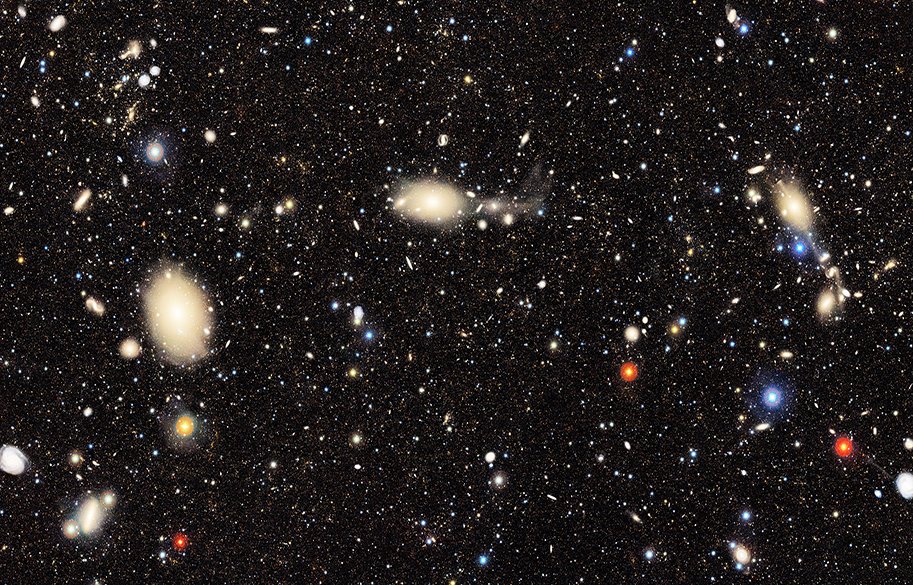
As recently as this past week, the observatory released its first LSST Camera image specifically intended for scientific use. It focused on a well-studied patch of sky known as the COSMOS field. Researchers built the final composite by stacking hundreds of individual observations together. The result contains more than 500,000 galaxies and over 50,000 stars, an almost incomprehensible amount of detail packed into a single frame. The observatory specifically dedicated the image to the people of Chile’s Coquimbo region, acknowledging decades of local support for astronomy in the area surrounding the site.
Recent Podcast Episodes

Recent Adventures



Subscribe Today!
Subscribe
Your Ad Here!

Other Adventures You May Like

Kitty Genovese and the “38 Witnesses” Story That Turned Out to Be Wrong

The Rohonc Codex: The Other Undeciphered Manuscript Nobody Can Crack